
- Chennai
- Tamil Nadu
- India
- World
- EntertainmentEntertainment
- Business
- Sports
- Lifestyle
- Technology
- Videos
- Explainers
- Editor's Picks
CHENNAI: A young Tharun Sekar was unaware that his fascination with musical instruments would lead him on an unconventional path, filled with learning and renaissance. It all started in Madurai, his native place, where the impact of independent music bands was deeply rooted in the 1980s. Taking inspiration from a few prominent members of such bands, Tharun wished to play the guitar in class eight.
When he came across a CD about the union of guitarists across the world, he discovered the lap steel guitar. Attracted to the Hawaiian guitar, Tharun wanted to learn its nuances. However, he couldn’t find one in the music stores in Madurai. “The only way to feel that guitar in my hand was by making it. I referred to YouTube on how to create the instrument. It was quite fascinating to explore the other end of music,” says Tharun, who then went on to pursue architecture.
Within a brief period, he created different types of guitars. A major turning point in Tharun’s life occurred during his internship at Auroville. “I had the opportunity to meet one of the important luthiers of Puducherry and was trained under him for eight months. Only during the training period did I understand that the guitars I made were at an amateur level. I learned the intricacies of wood, how much it resonates with sound, and delved deep into history,” he shares.
Clay kudamuzha (1)

Tharun was also into western music. “It was quite hard-hitting when I realised that I was not giving importance to India’s ancient instruments. I wished to address that issue and started researching. In western music, people enhance the instrument, and it evolves. I wanted to apply the same to Indian musical instruments and started Uru in 2019.”
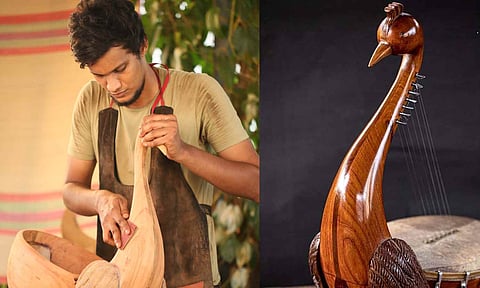
Beginning with the sarod, Tharun also had the opportunity to recreate the yazh (Lyre) for his friend in Madurai, who was part of the archaeological documentation in Keezhadi. “Researching the lyre was the biggest challenge because there was hardly any information about the instrument, and the available details were impractical. That pushed me to reinvent the instrument and use it for playing music,” he adds.
He took references from the Sangam literature and spent considerable time getting the facts right. “Understanding the details from the aesthetic descriptions in the literature was quite difficult. It took a year to create the first lyre, the sengotti yazh, with seven narambu (strings).” To date, Tharun and his team have revived eight different types of lyres, including a seven-foot one.
Tharun didn’t stop with the lyre - he went on to explore more ancient instruments, and next on his list was the kudamuzha, an ancient instrument from the land of Tamil. Also known as panchamukha vadhyam, it is a unique drum with five faces. The instrument is used in temple festivals.
“Only one kudamuzha exists at the Arulmighu Shri Thiyagarajar Temple in Thiruvarur. Tracing its origins to the Chola period, we have tried to recreate the instrument but in a portable format with different materials like brass. Reviving such ancient instruments will help us shed light on the influence of history and culture in music,” Tharun believes.
Apart from this, he is also in the process of rediscovering the sarinda, an instrument based in West Bengal. Tharun’s vision is expanding further. “I have a list of 40 instruments to be revived. We want to build an ecosystem surrounding these traditional Sangam-era instruments. Music is an experience, and electronic media is already popular. Lyre, kudamuzha, and others will be instrumental in providing a unique musical experience,” says Tharun, whose confidence comes from an experiment. To raise awareness about their vision, he started Uru Paanar in 2023, a musical band that performs only using traditional instruments.
“My ultimate goal is to create a space for eastern instruments just like western musical instruments in the global music market,” Tharun envisions.