
- Chennai
- Tamil Nadu
- India
- World
- EntertainmentEntertainment
- Business
- Sports
- Lifestyle
- Technology
- Videos
- Explainers
- Editor's Picks

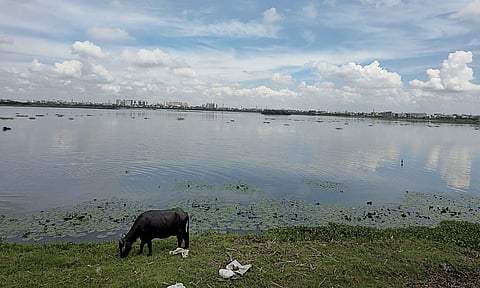
CHENNAI: The faecal coliform and total coliform levels in Korattur lake has exceeded the limits by several times, suggesting that the lake has become a cesspool, revealed a periodic analysis conducted by the Tamil Nadu Pollution Control Board (TNPCB).
Following the finding, the TNPCB has warned the Chennai Metropolitan Water Supply and Sewerage Board (Metro Water) to arrest inflow of raw sewage into the lake or face action.
As per a report submitted by the TNPCB to the southern bench of the National Green Tribunal (NGT) that is hearing a case pertaining to the pollution in Korattur lake, the environmental watchdog collected samples of lake water from the areas Ondiveeran Temple and Seethamman Temple on various occasions between September 2024 and February 2025.
The samples collected at the two spots in September 2024 showed total coliform levels of 1,659 MPN/100ml (most probable number per 100 ml) and 2,239 MPN/100ml, respectively. Similarly, the samples collected in October 2024 revealed total coliform levels of 2,599 MPN/100ml and 3,842 MPN/100ml, respectively.
Samples collected at the same spots in November 2024 showed total coliform levels of 1,905 MPN/100ml and 3,293 MPN/100ml. In December, the levels were 2,260 MPN/100ml and 3,850 MPN/100ml. In February 2025, the total coliform levels were found to be 3,635 MPN/100ml and 3,433 MPN/100ml at the two spots, respectively.
As per the Central Pollution Control Board norms, the total coliform level should be less than 500 MPN/100ml for outdoor bathing.
Apart from the total coliform levels, levels of biological oxygen demand (BOD), chemical oxygen demand (COD), and other parameters are also higher than the acceptable limits.
In a communication sent to Metro Water a few days ago, the TNPCB informed that an inspection team found sullage was being discharged from the storm water canal connected to the Ambattur surplus canal at Pattaravakkam Station Road, and the flow of sewage into the lake from the canal.
"Samples have been collected regularly in the Ambattur canal stretch and Korattur lake. The result of analysis (ROA) of samples collected from September 2024 to February 2025 reveals the presence of BOD, COD, faecal coliform and total coliform, indicating that the Ambattur surplus canal is contaminated with untreated sewage from the nearby unserved areas," the letter said.
The TNPCB also directed the water manager to furnish the status of implementation of underground sewerage system in MKB Nagar, Teachers Colony, Dhobi Colony, Ramapuram, Alagesan Nagar, Gnanamoorthy Nagar, Pattaravakkam, Meenambedu, Karukku, Mannurpet, and Mangalapuram in Ambattur zone, apart from stopping sewage from entering the lake.
Meanwhile, the Metro Water, in another case, informed the NGT that present water and wastewater treatment plants are unable to deal with the harmful perfluoroalkyl and polyfluoroalkyl substances (PFAS), commonly called ‘forever chemicals’, due less knowledge and infrastructure.
Explaining that PFAS remediation in water treatment on a large scale was not feasible yet, Metro Water suggested corrective action to stop PFAS at the source point itself. PFAS have been used globally for water and oil repelling purposes such as coating on kitchen cooking ware, food packaging, wax, paint, and aqueous fire-fighting foams.