
- Chennai
- Tamil Nadu
- India
- World
- EntertainmentEntertainment
- Business
- Sports
- Lifestyle
- Technology
- Videos
- Explainers
- Editor's Picks

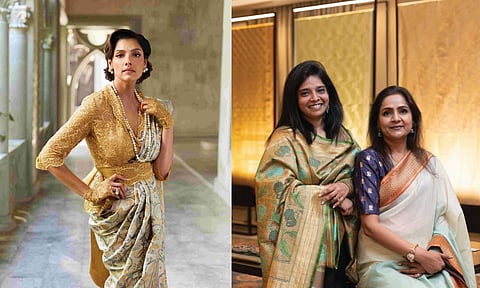
CHENNAI: With each collection, Swati and Sunaina deepen their commitment to the art of handwoven textiles. Known for their richly crafted Banarasi sarees rooted in rare weaving traditions, their latest collection called Varanasi to Versailles opens a new chapter by exploring the unexpected intersections between India and France.
This collection pays tribute to the elegance of French lace, incorporating its distinctive elements into specially designed brocaded textiles. “Our visits to France made us appreciate how beautifully lace has been used with fine silks. The making of lace itself is a very complex process, and it is unique to France. There are only a handful of units that continue to make lace in the traditional form," says Swati.
It was this refined craftsmanship that inspired them to bring together pure Chantilly or Guipure lace with the finest handwoven zari sarees. “The idea of combining these two worlds felt like a perfect marriage,” Swati adds.
The process of integration unfolded in two distinct phases. “The more challenging part was to translate lace-like patterns into a woven format. That required a fresh approach to design, and our graph makers and weavers had to be trained to treat those designs differently. After some hit and trial, we finally achieved a woven look that resembled Chantilly lace," she explains,
To complement that effort, a new all-women unit was set up to work with authentic Chantilly lace from the best ateliers in France. Each lace piece was carefully hand-stitched into the woven textiles; an experimental process that gradually found its balance and finesse. “It was slow, detailed work, but it helped us create sarees that felt complete and unique,” Sunaina reflects.
Their interest in Indo-French design conversations is rooted in a wider exploration of textile traditions from around the world. “We’ve studied Gyasar weaving from Tibetan heritage, Persian miniature design in our Aab-e-Zar collection, and so on. Each culture brings its beauty and discipline," says Swati.
With France, the connection has always been special. “Banaras and France are linked through the Jacquard machine, a French invention that allowed handloom weavers to create complex patterns. Our trip to French museums opened our eyes to the beauty and refinement of their textile history. But hand-weaving there is almost extinct. That’s what inspired us to bring their design language to life through our living tradition of handlooms," Swati explains.
The collection is on display at The Folly, Amethyst, Royapettah.