
- Chennai
- Tamil Nadu
- India
- World
- EntertainmentEntertainment
- Business
- Sports
- Lifestyle
- Technology
- Videos
- Explainers
- Editor's Picks

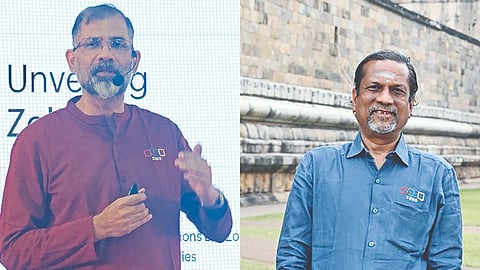
KUMBAKONAM: Zoho Corporation on Friday formally entered the enterprise resource planning (ERP) market with the launch of Zoho ERP, while signalling that Zoho Pay will roll out soon, founder and chief scientist Sridhar Vembu said, positioning payments as the next layer on top of the company’s enterprise software stack.
The ERP platform was launched from Kumbakonam, in Vembu’s hometown, reinforcing Zoho’s long-held belief that world-class software can be built far from India’s metros. Part of the ERP product team operates from Zoho’s regional office in Kumbakonam, which has seen rapid expansion in recent years.
From a 20-member team in 2020, Zoho has scaled the Kumbakonam facility by transforming marriage halls into workplaces, to around 200 people, as part of its effort to replicate the Tenkasi model of decentralised product development. Two such facilities are already in operation where even a Zoho School of Technology operates, providing opportunities for undergrads to take up on the job training with stipends of Rs 10,000. These undergrads are from in and around Kumbakonam as they chart out their career path with an assurance of being absorbed in Zoho itself.
Vembu said plans are underway to develop a full-fledged campus in the region with capacity for up to 2,000 employees, depending on market adoption.
Zoho’s ERP foray is the culmination of nearly 18 years of work in finance and operations software. As per Sivaramakrishnan Iswaran, global head, Zoho’s Finance and Operations Business Unit and CEO of Zoho Payment Technologies, the push was driven by a clear market gap. “Most global ERPs are retrofitted for India. They are not designed for evolving regulations like GST and e-invoicing,” he said. “Enterprises want something powerful, customisable and affordable, without the heavy consulting-led cost structures.”
Unlike stitched-together platforms, Zoho ERP is built as a unified system, embedding finance and operations by design, while integrating seamlessly with Zoho’s CX and workplace products. The initial rollout will focus on manufacturing, retail, distribution and non-profits, sectors where Zoho already has strong customer demand.
Zoho pegs the addressable ERP market at $300 billion, targeting customers from small businesses to very large enterprises. The company’s longterm confidence in tackling complex categories is reflected in its investment strategy with nearly 50 per cent of Zoho’s global headcount being deployed in R&D, a figure Vembu has often highlighted as central to building durable software platforms.
A key differentiator for Zoho ERP is its alignment with India’s Digital Public Infrastructure (DPI), including Bharat Connect and Banking Connect, which enable systems to exchange data seamlessly and significantly reduce transaction friction for businesses and MSMEs.
This DPI-first architecture also underpins Zoho Pay, which Vembu said will roll out soon.
The natively-embedded ERP workflows cover invoicing, payroll, compliance, POS and QRbased payments. “Businesses are paying for assurance and accuracy,” Vembu said. “That assurance factor becomes critical in enterprise software.”
“By creating opportunities for local youth, we are helping reverse talent drain, strengthening the regional economy, and advancing our nation-building efforts by building swadeshi technology from rural India,” Shailesh Davey, CEO, Zoho Corp, said in a release.
Zoho has already seen strong interest in its POS and QR offerings launched last year, largely driven by its existing accounting and billing customer base.
Alongside enterprise software, Zoho continues to invest in semiconductor chip design through ventures such as Signalchip, Netrasemi, though Vembu reiterated that chip fabrication remains “a very different game”.
Taken together, Zoho’s ERP entry, impending Zoho Pay rollout and expansion in Kumbakonam underline a long-term bet on building globally-competitive enterprise infrastructure from India’s heartland.