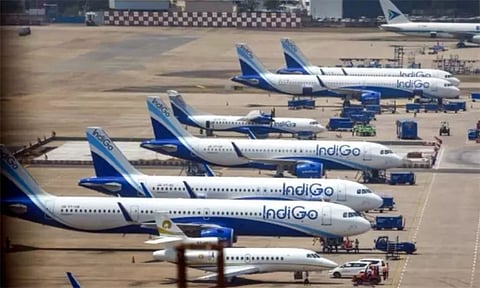

NEW DELHI: The widespread disruptions in IndiGo flights, resulting from the airline's failure to plan for aviation regulations communicated to industry more than a year in advance, could result in financial damage from loss of revenue as well as potential penalties for cancellations, Moody's Ratings said on Monday.
In a note, Moody's said the disruptions are "credit negative" for the airline. "Despite temporary reprieve, failure to effectively plan for new aviation regulations is credit negative."
The disruptions, which coincided with peak winter schedules, resulted in over 1,600 flight cancellations on December 5, after similar operational issues in November left more than 1,200 flights grounded. Flights cancellations started on December 2 and the airline is yet to restore normalcy. More than 500 flights were cancelled on Monday.
"The disruptions are credit negative because IndiGo could face significant financial damage from loss of revenue because of flight cancellations, refunds and other compensation to affected customers, along with potential penalties imposed by DGCA," Moody's said.
Moody's cited the airline's "significant lapses in planning, oversight and resource management" as the primary cause, noting that the regulations had been communicated to the industry more than a year in advance.
The airline, rated Baa3 with a stable outlook, last week received a temporary exemption from the Directorate General of Civil Aviation (DGCA) for its Flight Duty Time Limitation (FDTL) rules, effective until February 10, 2026.
This followed a week-long period of IndiGo reporting massive delays and cancellations of its flights caused by a mix of regulatory changes and weather conditions that exacerbated the company's lapses in planning, amid a peak winter-schedule for the airline.
The Phase 2 FDTL regulations, introduced on November 1, 2025, classify any duty between midnight and 6 a.m. as night duty and reduce permissible landings within 24 hours from six to two or three. While intended to improve safety and manage crew fatigue, the rules are among the strictest globally.
IndiGo's lean operational model, effective under normal conditions, lacked resilience to absorb the regulatory changes, triggering a system-wide schedule reset.
DGCA has issued show-cause notices to IndiGo CEO Pieter Elbers and COO Isidro Porqueras, raising questions about leadership continuity. The Ministry of Civil Aviation (MoCA) has directed the airline to process all customer refunds by December 7, without levies, while potential penalties remain under consideration.
"Recent flight disruptions underscore significant lapses in planning, oversight and resource management by IndiGo because the new regulations had been known to the industry for more than a year. The airline's lean operations, which provide cost efficiencies in stable times, lacked the resilience needed for this change in regulations, leading to the need for a system-wide reboot that led to cancellation(s)," Moody's said.
IndiGo's on-time performance dropped to 68 pe cent in November from 84 per cent in October, with over 1,200 cancellations in November.
The situation worsened with routine winter fog, leading to further cancellations and leaving many passengers stranded.
The rating agency said, following a schedule reset over December 5-6, IndiGo has gradually restored services. The CEO confirmed that 1,650 of its 2,200 daily flights are operational, and expected a return to full schedules by mid-December.
"The DGCA exemption remains effective until February 10, 2026, subject to a mandatory review every 15 days based on operational and compliance reports submitted by IndiGo. These reports must detail crew utilization, steps to enhance crew availability, operability improvements and revised crew planning measures. Additionally, IndiGo must submit a 30-day road map for full compliance with FDTL regulations, including timelines for achieving 100 per cent adherence," it said.
The Ministry of Civil Aviation (MoCA) has directed IndiGo to process all customer refunds by December 7 without any levies.
While no penalties have been imposed yet by MoCA or the DGCA, they remain a possibility in the near future, Moody's said.
"We have downgraded IndiGo's issuer category score for human capital to 4 from 3, reflecting the adverse impact of slower hiring on the airline's operations. Although IndiGo does not have employee unions, its pilots, through broader pilot associations in India, possess significant collective bargaining power. "IndiGo's governance issuer category score of 3 for management track record captures management's lack of judgment and preparedness for the impending regulatory changes," it said.
There is no change to IndiGo's overall social issuer profile score of S-4, which indicates high credit exposure to social risks, and its governance issuer profile score of G-3, representing moderate credit exposure to governance risks.
"Although the fundamentals of IndiGo's Baa3 rating remain intact, including its dominant market share, low penetration rates for air travel in India, strong macro growth fundamentals and IndiGo's long-term leverage sustainable below 3.5x, the airline's profitability will be negatively impacted in the current fiscal year ending March 31, 2026," it said.
Moreover, there will be some reputational damage for IndiGo, which may hurt the company, especially in its code-sharing arrangements.
"However, quantitative impact of the disruption remains uncertain at this point as the scale and profitability of IndiGo's operations evolve following adjustments to comply with FDTL regulations," the rating agency added.