
Chennai
I first met him in Bengaluru, when he came to visit a unit of Defence Research and Development Organisation (DRDO) in Chennai, as the head of the country. I had been requested to choreograph some entertainment for the evening, planned in his honour, and also cook one dish. I presumed that Dr Abdul Kalam would like modern entertainment, as he had travelled so far and wide. I had the youngsters dancing to Jailhouse Rock by Elvis Presley, and the older people doing a classical welcome dance, to Vande Maataram.
The former he sat through, but without any expression and the latter, he got up for and applauded enthusiastically. I later realised that not only was he simple, his tastes and likings also displayed humility and sensitivity that enshrined his love for India. Be it music or culture, it was Indian all the way for him; especially food as he preferred South Indian dishes like appam for break-fast and sambar for lunch. Dinner was standard rasam and rice. All this I gathered when I got ten minutes alone with him for an interview. We spent the time discussing food and how he had become a vegetarian and his favourite dish was what his mother used to cook — ari urundai kozhambu.
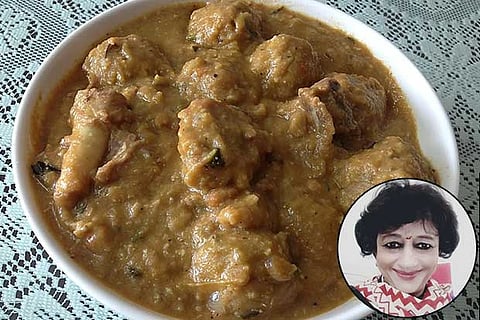
His father leased out fishing boats and mother was a busy housewife. Along with Vedas, he picked up love for traditional southern food like the dish mentioned above. Called thakkadi or thikkudi, the dish is actually made with mutton but since Dr. Kalam turned vegetarian, meat was substituted with brinjal and potatoes by his mother.
Thakkadi originated when Arab settlers, who came as traders married the local Tamils and Sri Lankans and settled in these regions. Rice being the staple diet of the south, makes flour and dough derived from it a stellar supporting actor in any South Indian kitchen. Made by cooking rice flour in boiling water with a spoonful of ghee, ari urundai kozhambu is a must-have.
The balls of rice obligingly accompany number of dishes, as its bland taste adapts well to any spicy curries or chutneys. In the olden days, it was cooked overnight, in large brass cauldrons, hung over wood fire.
Thikkudi – Ari urundai Kozhambu
Serves: 3-4
Calories per serve: 280 cal.
Ingredients
Shredded/grated coconut: 1 cup | Roasted white rice flour: 2 cups | Tamarind paste: 1 tsp | Lemon juice: 1 tsp | Ginger-garlic paste: 2 tsp | Red chilli powder: 2 tsp | Turmeric powder: 1 tsp | Cumin powder: 2 tsp | Coriander powder: 2 tsp | Green cardamom: 10 pods | Black cardamom: 6 pods | Cinnamon: 10 sticks | Bay leaf: 10 | Fresh curry leaves: 1/2 cup | Green chillies (diced): 4 | Ginger: 1 inch piece, grated | Garlic (chopped): 3 cloves | Tomatoes (chopped): 1/2 cup | Red onions (chopped): 1 cup | Potatoes: 250 grams | Brinjal: 250 grams | Coco-nut/sesame oil: 1/4 cup | Rock salt: to taste | Coriander (for garnishing): 1/4 cup | Mustard seeds: 1 tsp | Fenugreek seeds: 1 tsp | Dried red chillies (broken into half): 2 | Cashewnut paste: 1/2 cup | Thick coconut milk: 1 cup | Water: as per requirement.
Method:
Kitchen Tip:
— The writer is a chef and author of Festive Offerings to the Gods
Visit news.dtnext.in to explore our interactive epaper!
Download the DT Next app for more exciting features!
Click here for iOS
Click here for Android