
- Chennai
- Tamil Nadu
- India
- World
- EntertainmentEntertainment
- Business
- Sports
- Lifestyle
- Technology
- Videos
- Explainers
- Editor's Picks
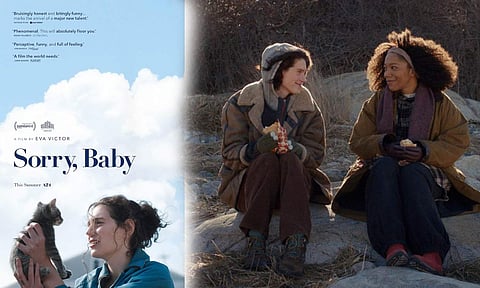
CHENNAI: It's been a season of popcorn entertainers. Films like F1, Jurassic World Rebirth, Superman, and The Fantastic Four: First Step took the box office by storm, overflowing with spectacle and escapism. Yet, amid these crowd-pullers, Eva Victor’s debut directorial Sorry, Baby stands out as a reminder of the purest joy of film-watching and its deeper purpose. Made especially for the festival circuit, its unsettling theme wrapped in a resonant calm makes it one of the finest films of the year.
Premiering at the 2025 Sundance Film Festival to raving reviews, Sorry, Baby quickly became one of the festival’s most-discussed titles. With acclaim pouring in across social media, I scroll through Letterboxd, where cinephiles log, review, and debate films, only to see unanimous praise. I begin watching the film with an open mind, without even knowing its cast, director, or story. What follows is nothing short of a revelation. Narrated across five chapters, the film drifts gently between past and present, unfolding at its own rhythm. Eva Victor not only helms the film but also plays the lead, grounding the narrative with a performance of quiet intensity.
The first chapter, The Year with the Baby, focuses less on plot and more on its characters and their bond. We meet Lydie (Naomi Ackie), visiting her old friend Agnes (Eva Victor) in rural England after years apart. Agnes, recently moved from a temporary post to a permanent one as an English professor, lives in solitude, haunted by unspoken scars. Around Lydie, she blossoms with joy and comfort, a happiness she cannot find elsewhere. But once Lydie returns to New York, Agnes sinks back into loneliness, her home a dark and confining space.
The second chapter, The Year with the Bad Thing, peels back the layers of Agnes’s past. Flashback five years, and we see Agnes as a promising graduate student, full of life and laughter, part of a study group led by literature professor Preston Decker (Louis Cancelmi). But one night, after a visit to Decker’s home, her world collapses. In a silent, dark yet shattering sequence, Agnes leaves the house in shock, overwhelmed by trauma. Later, she confides in Lydie that Decker has sexually assaulted her.
From here, the film shifts focus to the aftermath rather than the incident itself. Agnes’s life turns into a cycle of fear and survival. Panic attacks, sleepless nights, and paranoia consume her. She repeatedly checks her doors, covers windows with newspaper, and even avoids stepping inside her neighbour’s house for a simple errand. Her clothes, once bright, fade into dull shades, reflecting her loss of vitality. The camera often remains static, as though her life is frozen in time. What makes the film truly special is the touch of tragicomedy Eva weaves into every scene. Through the performances and dialogues, there is a faint smile that lingers, yet beneath it, the heart carries an unspoken weight of pain.
Sorry, Baby also delves into the systemic neglect that surrounds her. A doctor’s probing questions during her medical visit deepen her discomfort. The university administration evades responsibility, leaving her further isolated. Eva captures not just the personal weight of trauma but also the failure of institutions meant to protect. It could be that she chooses not to reach out to a counsellor, perhaps out of fear of how they might react, or the pain of having to relive the incident all over again. Maybe that is why she feels truly at home only when she is around Lydie.
Watching these moments forces me to reflect on how Tamil cinema, which I grew up with, has long mishandled sexual assault. In older films, the ‘solution’ often means marrying the perpetrator to the victim, something even seen in prominent films like veteran K. Balachander’s Moondru Mudichu (1976) or actor Rajinikanth’s Panakkaran (1990). As a boy, I could not fully comprehend the resolution of such portrayals, and even wondered about the logic behind them. Over the years, representation improves slightly, but it still often reduces victims to a stock device, used merely to drive the protagonist’s revenge. Films like Theri (2016), Dear Comrade (2019), and Maharaja (2024) follow suit. Even Nerkonda Paarvai (2019), a remake of the Hindi film Pink, though stronger in voicing justice and breaking stereotypes, struggles to capture the lasting psychological impact on survivors.

This is where Sorry, Baby feels truly different. Agnes is not a narrative device; she is the story itself. Eva Victor’s performance captures the deep agony of a woman struggling to live with trauma, while her writing refuses to sensationalise it. The film insists that trauma is not an isolated incident to ‘move past’ but a shadow that grows heavier without support.
The honesty reminds me of a Tamil film that, though far from perfect, came close to approaching the subject with similar seriousness, S.U. Arun Kumar’s Chithha (2023). In it, Shakthi (Nimisha Sajayan) tells Easwaran (Siddharth), after the abuse of his niece, that what the child needs more than revenge is his presence and care. That simple but often ignored truth lies at the heart of Sorry, Baby.
Watching this film unsettles me deeply. It makes me realise how little I understand about the ongoing burden victims carry, and how inadequately cinema often serves them. Sorry, Baby refuses to let us look away. It demands empathy, accountability, and compassion. Eva Victor’s debut is not just among the year’s most remarkable films, it is also a stark reminder that cinema can illuminate what society would rather leave in the dark.