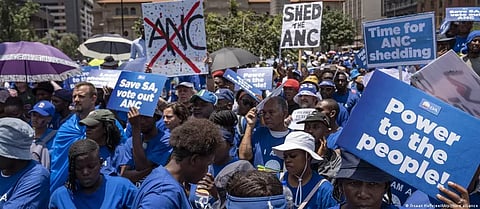

For the last 12 years, Dimakatso Ragedi has lived with her mother and daughter in a low-cost house in Cosmo City, a residential project in an upmarket suburb of Johannesburg that was co-financed by the ruling African National Congress (ANC) party. The young woman and her family know too well that power outages are a part of everyday life in South Africa.
Load shedding — the practice of scheduling power cuts to keep the country’s power grid from collapsing — means that Ragedi’s house is often plunged into darkness, her kettle stops boiling, her washing machine grinds to a halt and she has no way to charge her cell phone.
“If the electricity stays away, we use a gas stove and rechargeable light bulbs,” Ragedi told DW. Ragedi’s standard of living has improved since 1994, the year Nelson Mandela became the president of a new post-apartheid democracy. In its first-ever election manifesto, the ANC had promised South Africans adequate housing, water, and electricity. Nearly three decades after taking power, the governing party barely manages to keep the lights on in people’s homes.
Raika Wiethe, who lives in Parkview, a green residential district in the north of South Africa’s economic capital Johannesburg, said that during the first half of the year, she experienced up to 12 hours of power outages every day. When South African President Cyril Ramaphosa hosted the BRICS summit in August, the energy supply was consistent — but power outages are more frequent now, said Wiethe.
The leaders of the five-country grouping met in Johannesburg to discuss expansion and increasing global influence. “Cyril Ramaphosa used the BRICS summit to enhance his own standing and significantly increase South Africa’s diplomatic weight in a changing global community,” said political analyst Daniel Silke. But that matters little to local politics, Silke said.
South Africans are concerned about fundamental problems on the ground, such as poor governance, rising prices, and unemployment, he said.
“The ANC needs to take more responsibility and make sure the lights don’t go out,” Silke told DW.
Eskom, the state-owned utility that produces 90% of South Africa’s electricity, has debts of around 21 billion euros ($19.8 billion) and is struggling with ailing coal-fired power plants that regularly break down. The company was mired in corruption scandals under former President Jacob Zuma. The daily blackouts across South Africa are affecting businesses and households that already suffer from severe inflation amid the country’s weakened economy. “The biggest fear is that there will be a complete collapse of the power grid,” Ragedi said.
Confidence in the ANC has dwindled. Before every election, the government promises more jobs and more houses for the poor, as well as less crime and corruption, Ragedi said. “But we are moving toward conditions like in Zimbabwe.”
Neighboring Zimbabwe went from a well-diversified economy into the region’s problem child during nearly four decades under the rule of former President Robert Mugabe. “We are a democracy, however at the moment it looks like we are an autocratic country, it is in shambles,” Ragedi said of South Africa.