
- Chennai
- Tamil Nadu
- India
- World
- EntertainmentEntertainment
- Business
- Sports
- Lifestyle
- Technology
- Videos
- Explainers
- Editor's Picks
The youth wing of an Islamist political party in Bangladesh stunned the country in September when it secured a landslide victory in student elections at the University of Dhaka, a bastion of left-liberal politics where the 2024 revolution was incubated.
It was the first clear indication that a new power broker had entered mainstream politics in Bangladesh, which had largely been dominated by two dynastic political parties since independence in 1971.
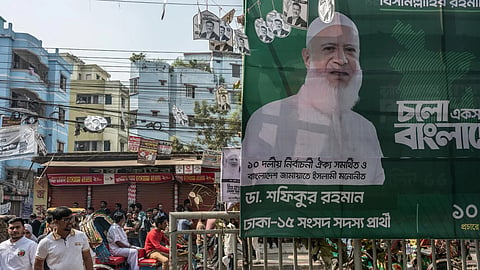
That shift became unmistakable in the first national elections since the 2024 revolution, when student protests toppled the government of Sheikh Hasina, widely criticised as authoritarian. Jamaat-e-Islami proved its early momentum was not an aberration, winning nearly a quarter of parliamentary seats. While the Bangladesh Nationalist Party (BNP), led by Tarique Rahman, secured a clear majority and is set to form the government, Jamaat recorded its strongest-ever performance, capturing 68 of the 297 seats.
Two months earlier, Jamaat had caused another surprise by forging an alliance with the National Citizen Party (NCP), established by leaders of the student uprising. The NCP campaigned for inclusive governance, political freedoms and women’s rights — positions that sit uneasily alongside one of Jamaat’s central tenets that women’s public participation should align with Islamic principles.
The emergence of Jamaat as a major political force reflects the tectonic political shifts triggered by the student movement, though not necessarily in the direction many student activists had envisioned. The NCP justified its alliance with Jamaat as a pragmatic attempt to enhance its electoral prospects, citing Jamaat’s extensive grassroots and student networks. Despite the partnership, the NCP secured just six of the 30 seats it contested.
Students who spearheaded the 2024 uprising, however, registered a separate political victory. In a referendum held alongside the election, voters overwhelmingly endorsed constitutional reforms designed to strengthen democratic safeguards and prevent a return to authoritarian rule. Proposed measures include establishing a bicameral legislature and imposing term limits on prime ministers.
Even so, analysts suggest the student movement may struggle to sustain its political momentum, mirroring earlier youth-driven uprisings such as the 2011 Arab Spring, which destabilised governments but struggled to institutionalise lasting political change.
“It will fizzle out,” said Mujibur Rehman, a political scientist at Jamia Millia Islamia University in New Delhi. Student-led movements, he said, often lack political experience and organisational depth to sustain long-term electoral relevance. Patronage-driven politics across South Asia demands loyalty networks that student organisations typically lack. “The politics and rhetoric that work on university campuses don’t necessarily translate into broader electoral success,” he added.
The NCP’s alliance with Jamaat, whose student wing, Bangladesh Islami Chhatrashibir, won elections in four major colleges between September and October, reflected a strategic attempt to retain political relevance. The partnership has simultaneously provided Jamaat long-sought political legitimacy and visibility while enabling it to project a more moderate public image.
Founded in 1941 and ideologically influenced by the Muslim Brotherhood, Jamaat remained politically marginalised in Bangladesh for decades, particularly after supporting Pakistan during Bangladesh’s independence struggle. Although it secured political space during earlier BNP-led governments — winning 18 parliamentary seats in 1991 and holding two Cabinet portfolios — it was largely suppressed during Hasina’s 15-year rule.
Despite political restrictions, Jamaat continued cultivating support among voters disillusioned with dynastic politics, especially younger demographics. Mosques and madrassas functioned as central organisational bases, helping sustain recruitment and ideological continuity across generations.
Broader geopolitical and social dynamics also aided Jamaat’s resurgence. The global post-9/11 political climate and the rise of Hindu nationalist politics in neighbouring India reinforced Islamist political mobilisation within Bangladesh, said Iftekharuzzaman, executive director of Transparency International Bangladesh, who contributed to reform efforts following the 2024 revolution.
He noted that Jamaat performed particularly strongly in constituencies bordering India, including Khulna and Rajshahi divisions. Domestic socio-economic grievances, including corruption, unemployment and political monopolisation, further pushed voters towards alternative political platforms. Jamaat also benefited from the absence of the Awami League — historically Bangladesh’s largest political party — which was barred from contesting the election, leaving a significant voter base unrepresented.
The origins of the student revolution lay in protests against a government job reservation system that provided quotas for various groups, including descendants of freedom fighters. The movement expanded dramatically after security forces cracked down on demonstrators under Hasina’s orders, transforming the protests into a nationwide anti-authoritarian campaign that ultimately forced her resignation and exile to India.
Both the BNP and Jamaat supported the protests, viewing them as opportunities to dismantle Awami League dominance and advance their respective political agendas. However, once the immediate crisis subsided, the process of designing institutional reforms encountered intense political disagreements and prolonged negotiations.
Several reform proposals drafted by 11 commissions established under the interim administration of Nobel laureate Muhammad Yunus faced resistance from major political stakeholders, including the BNP and Jamaat.
Policy conflicts became particularly pronounced over gender reforms. The Women’s Affairs Reform Commission proposed measures including equal inheritance rights, expanded female political representation and formal recognition of sex work as a profession. Jamaat leader Shafiqur Rahman rejected both the commission and its recommendations. He later sparked controversy by comparing women working outside the home to prostitution in a social media post, which his office subsequently claimed resulted from hacking.
The NCP’s alliance with Jamaat provoked strong criticism from women activists and protest leaders, many of whom viewed it as a betrayal of the movement’s egalitarian ideals. Student leaders defended the decision as a strategic necessity rather than ideological alignment. Building a nationwide organisational structure within a year was unrealistic, they argued, making electoral alliances essential within Bangladesh’s intensely competitive political environment.
The election results illustrate a broader recalibration of Bangladeshi politics. While the student uprising dismantled an entrenched political regime and created momentum for democratic reform, it also opened political space for ideologically distinct forces possessing established grassroots networks and institutional resilience.
The New York Times
