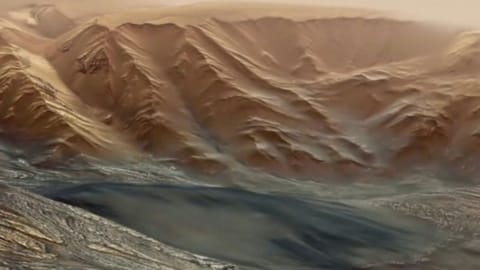

A recent study suggests Mars was warm and wet billions of years ago, challenging the long-standing theory that the planet was largely cold and icy. The findings carry important implications for the possibility that life may once have developed on the Red Planet.
Whether Mars was ever habitable has fascinated scientists for decades. Like Earth, Mars is about 4.5 billion years old, with its geological history divided into distinct epochs. The latest research focuses on the Noachian epoch, spanning roughly 4.1 to 3.7 billion years ago, a period that coincided with the Late Heavy Bombardment (LHB), when the solar system experienced frequent and catastrophic meteorite impacts.
Mars still bears striking evidence of this violent era. The Hellas and Argyre impact basins, each stretching over a thousand miles, are large enough to contain volumes of water exceeding that of the Mediterranean Sea.
Despite the hostile conditions implied by such impacts, scientists believe this period may also have been the most favourable for life on Mars.
Several geological features support this possibility. Ancient dried river valleys, lake beds, deltas and possible coastlines indicate widespread liquid water activity during the Noachian. However, scientists remain divided over the climate that produced these landforms. One theory proposes a cold, icy Mars where occasional melting occurred due to volcanic activity or meteorite impacts. The alternative view suggests a warm, wet and largely ice-free environment.
Complicating this debate is the early Sun’s lower brightness. During the Noachian, the Sun emitted about 30% less heat than today. For Mars to sustain a warm climate under such conditions, it would have required a much thicker atmosphere rich in greenhouse gases such as carbon dioxide. Yet at high pressures, carbon dioxide tends to condense into clouds, weakening its greenhouse effect, making the cold scenario appear plausible.
Fresh evidence from NASA’s Perseverance rover, which landed in Jezero crater in February 2021, offers new insights. Jezero was chosen because orbital images revealed fan-shaped deposits formed by flowing water entering what was once a crater lake. The rover has identified clay-rich sediments within ancient channels carved through the crater walls.
Researchers analysed aluminium-rich clay pebbles known as kaolinite found in these deposits. The pebbles show signs of intense weathering and chemical alteration by water during the Noachian. Notably, they are depleted in iron and magnesium but enriched in aluminium and titanium.
This chemical pattern suggests they were not formed by short-lived hydrothermal activity from volcanic heat or impact-driven melting. Instead, the evidence points to sustained rainfall and moderate temperatures.
The researchers also found strong similarities between these Martian clay compositions and comparable clay deposits formed during warm, wet greenhouse phases in Earth’s history. They conclude that these pebbles likely represent some of the wettest and potentially most habitable phases of Mars’ past, possibly lasting from thousands to millions of years.
Scientists emphasise that any claim of life must satisfy the “Knoll criterion”, which requires biological explanations to be the only viable interpretation of evidence.
Whether Martian samples will meet this standard remains unknown. Nevertheless, the research presents a compelling picture of a once wetter and potentially life-supporting Mars, starkly different from today’s barren landscape.
Gareth Dorrian is Post Doctoral Research Fellow in Space Science, University of Birmingham
The Conversation