
- Chennai
- Tamil Nadu
- India
- World
- EntertainmentEntertainment
- Business
- Sports
- Lifestyle
- Technology
- Videos
- Explainers
- Editor's Picks

Authoritarianism and neoliberalism have become strange bedfellows in our time. One cannot stand dissent, and the other sees an opportunity to profit from it. As an example of this strange union, we have the government of Chhattisgarh. Fresh from “eliminating” hundreds of Maoists in Bastar, it has instructed the municipality of Raipur to extract a fee from anyone staging a protest at the designated site in the state capital, the Tuta Dharna Sthal.
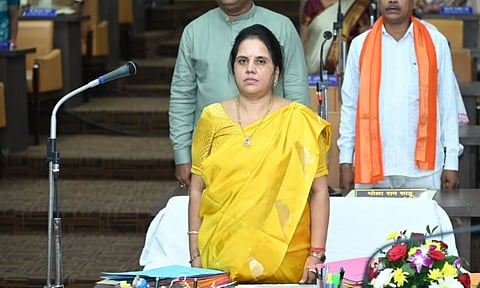
Mayor Meenal Choubey, of the BJP, naturally says the toll of Rs 500 (duly to be raised to Rs 1,000) levied on protest organisers will go towards “cleaning and maintenance” of the site. The town elders think this is a cool idea and have resolved to go further and impose a charge of Rs 5 per square foot on every pandal erected there.
This is tantamount to a tax on dissent, of course, but it is not without precedent. According to a resource paper written by the eminent lawyer Vrinda Grover, the India Against Corruption movement was charged Rs 50,000 for use of the Ramlila Maidan in New Delhi in 2011. The fee was abolished in 2018 (when the Aam Aadmi Party was in power), but the requirement for a security deposit of Rs 5,000 remains, as it does in several other cities.
Although a flat-out protest fee of the sort charged by Raipur is rare, municipalities and the police in Indian cities do charge nominal administrative costs. Since 2019, however, this has begun to evolve into formal tariffs on protest activities and, further on, into punitive recovery of costs for damage. That year, the Mangaluru police in Karnataka began collecting a fixed fee for protests, such as Rs 500 per day for peaceful marches and Rs 75 per day for the use of loudspeakers.
Such charges are usually justified as recovery of law enforcement, maintenance, and sanitation costs, but there’s a point at which they cease to be merely that and serve as a deterrent to dissent. While the Raipur Municipal Corporation seems to have been inspired by Mangaluru, it is just as likely that it acquired the contagion from an altogether more malevolent source, Uttar Pradesh, where the authoritarian government of Yogi Adityanath has enacted punitive recovery as law.
In that state, tribunals established under the UP Recovery of Damages to Public and Private Property Act (2021) can order full recovery of costs, including property attachment, for any damage caused by protests. Expenses incurred by the authorities for law enforcement can be charged to the organisers. Although the Allahabad High Court criticised this as a violation of constitutional rights, such measures were invoked after several protests, including against the Citizenship Amendment Act in 2019–20. Last year, Uttarakhand passed similar legislation, mandating fines up to Rs 8 lakh. So, we know where this is going.
Levies of the sort extracted by Raipur and penalties imposed by the UP Act act as a two-pronged encroachment upon the freedom of assembly. One seeks to monetise dissent, a tempting proposition for every cash-strapped municipality in the country. The other seeks to deter it altogether, allowing the regime of the day to target select communities. Together, they are of a piece with the authoritarian trend to keep the people ignorant and preserve a false consensus.