
- Chennai
- Tamil Nadu
- India
- World
- EntertainmentEntertainment
- Business
- Sports
- Lifestyle
- Technology
- Videos
- Explainers
- Editor's Picks
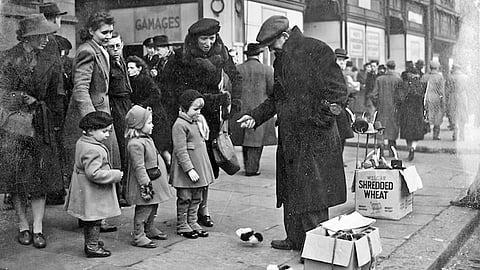
NEW DELHI: Eighty years ago, Britain marked its first peacetime Christmas since 1938. It was a moment of relief and hope, yet a look through newspaper archives reveals a more complex picture. Christmas 1945 was an austerity Christmas, in which grief and suffering, remembrance and loneliness mingled with reunions, church attendance and subdued celebration.
It was the first Christmas under the Labour government elected earlier that year, although Prime Minister Clement Attlee did not address the nation. Instead, the Christmas broadcast came from King George VI, who reminded listeners that Britons still had to “make a little go a long way”.
Britain was close to bankruptcy and had negotiated a colossal loan from the United States. The Times reported that extra meat, margarine, sugar and sweets, “allocated in good time”, would allow “a near approach to traditional fare in most homes”. Rationing, however, remained firmly in force, and for many the main priority was simply to get home to their families.
On December 22, the mass-circulation Daily Mirror reported that “with only three days to go till Christmas, mainline stations were jam-packed with servicemen and civilians anxious to get home for the greatest get-together holiday for six years”. “Here and there,” it added, “was a lucky passenger with a turkey or goose wrapped in brown paper to take home for the Christmas feast.”
The Labour-supporting Daily Herald struck a tone of realism tempered with optimism. “You may not have a turkey or much coal. Toys are scarce and taxes heavy. But have you reflected how much better off we are than a year ago?” it asked.
The paper reported that the railway network was running “duplicate and triplicate trains” on some routes, but demand still far outstripped capacity. “The first Christmas of the peace began with a battle – the battle of Waterloo,” it noted, describing “long queues four abreast at Euston” and parcels piling up at King’s Cross Station.
Not everyone would make it home. The Daily Mirror, staunch in its defence of servicemen, reported a “War Office Muddle” that meant men who had “spent five Christmases abroad” were “still being sent overseas, despite a War Office promise that they would not be”. This was because essential posts still needed to be filled.
The Daily Mail struck a lighter note, reporting a BBC broadcast of Bach’s Christmas Oratorio.
Despite these moments, the scale of loss weighed heavily. Britain had lost about 348,000 military personnel and 70,000 civilians. Churches across the country marked the season with remembrance. The Times carried photographs of choristers practising at Salisbury Cathedral, where carols were sung on Christmas Eve and Christmas Day.
The Listener captured the mood simply and powerfully. “Most of us can be happy, if not extravagantly merry this Christmas,” it wrote. “Most of us, but not all. There will be gaps in many family circles, faces missing, some of whom will not be seen again.”
As people around the world today face destruction and deprivation comparable to that endured between 1939 and 1945, Christmas 1945 remains a reminder that peace, even when austere, was reason enough for quiet celebration.
