- Chennai
- Tamil Nadu
- India
- World
- EntertainmentEntertainment
- Business
- Sports
- Lifestyle
- Technology
- Videos
- Explainers
- Editor's Picks
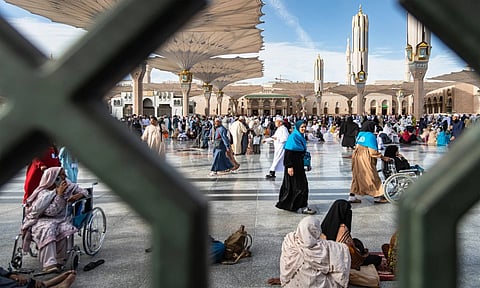
Lots of people in Saudi Arabia have a soft spot for Donald Trump. They think of the American president as a straight-shooting businessman — someone who talks of interests and not values, who won’t lecture them about human rights and who shares their own distaste for woke progressive dogma.
If you’re no fan of Saudi Arabia, or of Trump, that’s just fine. You can add it to the list of reasons to disdain the Saudis, right after religious intolerance, curtailment of free speech and beheadings. But after spending nearly two years as US ambassador to Saudi Arabia and getting a front-row seat to its remarkable transformation, I’d urge the doubters to look carefully at what’s really going on there, at what the president will see and hear during his visit to Riyadh this week, and how American national security could benefit from a successful visit or suffer from a bad one.
Saudis and their leaders will almost certainly regard Trump’s decision to make his first state visit of this term to their country — just as he did in his first term — as an authentic gesture of respect. This stands in contrast to President Joe Biden, who began his administration after pledging on the campaign trail to make Saudi Arabia a pariah. The US-Saudi relationship did eventually get better under Biden — much better, actually — particularly after we began negotiating agreements that stood to bring the two countries together as treaty allies and economic partners, establish diplomatic relations between Saudi Arabia and Israel and strengthen the prospects for Palestinian statehood. But many Saudis nonetheless looked forward to Trump’s return to the White House, and his return to Riyadh.
A lot has happened since Trump visited in 2017. Mohammed bin Salman officially became crown prince just a month later. The new leader had been preoccupied with consolidating his control of the Saudi state and a horrific war against the Iranian-supported Houthi movement in Yemen. Vision 2030, the program of social and economic transformation that MBS conceived and still assiduously leads, had recently been launched and had yet to fully capture the Saudi imagination. And Saudi women still couldn’t legally drive.
The nation’s transformation since then has been astonishing. Most of the so-called guardianship laws, which had governed nearly every aspect of Saudi women’s lives, have been dismantled; Saudi women now can work in every industry and government agency. A few years ago, women couldn’t attend soccer games; now there is a professional Saudi women’s soccer league. The religious police who used to be an annoying and sometimes terrifying fixture of life in the kingdom are nowhere to be seen. Saudi Arabia is now one of the largest global investors in renewable energy, part of a strategy to ensure a prosperous future when it can no longer depend on its vast oil reserves.
From afar, what MBS has done is often dismissed as public relations. But during my time as ambassador in Riyadh, I found the mood to be vastly different than it was during my own first visit, 15 years ago. The country feels more energized, more confident, vastly more ambitious, certainly more nationalistic, but also just plain happier. Many Saudis, even those who don’t love every change, credit MBS with the transformation.
Of course, it’s not a perfect picture. The country still makes liberal use of the death penalty, even while judicial transparency is lacking. Saudi border forces have been accused of shooting at migrants trying to cross into the country from Yemen. There is little tolerance for anything that smacks of political dissent. And despite Saudi investments in renewable energy, the kingdom remains quite dependent on pumping oil to fund its social and economic transformation.
But I would argue that Saudi Arabia is moving fast on a better path — and its success is profoundly in America’s interest. To signal that America wants Saudi Arabia to succeed, Trump could start by easing the export of the advanced chips that would keep its growing AI industry connected to ours, and the defense systems that bind its military to ours. He could tell MBS that America’s universities will always welcome Saudi students.
What Trump may hear in return is that Saudi Arabia is determined that nothing upset its transformation — no regional conflicts, no economic disturbances, no Houthi missiles and no domestic unrest.
The Saudi leader may also be looking around at America’s deteriorating relationships with its closest allies and wondering: If this is how America treats its friends, how will it treat us down the road? A treaty that binds us to the Saudis would also bind the Saudis to us — to our unpredictability, to our growing antagonism to alliances, and to our willingness to upend global economic structures that on balance have long served the Saudis and the US well.
©️The New York Times Company
