
- Chennai
- Tamil Nadu
- India
- World
- EntertainmentEntertainment
- Business
- Sports
- Lifestyle
- Technology
- Videos
- Explainers
- Editor's Picks
There are many ways to explain the two biggest conflicts in the world today, but my own shorthand has been that Ukraine wants to join the West and Israel wants to join the Arab East — and Russia, with Iran’s help, is trying to stop the first, and Iran and Hamas are trying to stop the second.
While the two battlefronts may look very different, they actually have a lot in common. They reflect a titanic geopolitical struggle between two opposing networks of nations and non-state actors over whose values and interests will dominate our post-post-Cold War world — following the relatively stable Pax Americana/globalization era that was ushered in by the fall of the Berlin Wall in 1989 and the collapse of the Soviet bloc, America’s chief Cold War rival.
Yes, this is no ordinary geopolitical moment.
On one side is the Resistance Network, dedicated to preserving closed, autocratic systems where the past buries the future. On the other side is the Inclusion Network, trying to forge more open, connected, pluralizing systems where the future buries the past. Who wins the struggles between these two networks will determine a lot about the dominant character of this post-post-Cold War epoch.
(And in case you’re keeping score at home, China under President Xi Jinping straddles the two networks, along with much of what’s come to be called the global south. Their hearts, and often pocketbooks, are with the Resisters but their heads are with the Includers.)
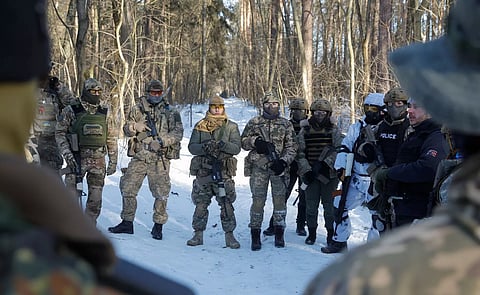
Ukraine is trying to break away from the choking Russian sphere of influence to become part of the European Union. Vladimir Putin is trying to block it, because he knows that if Slavic Ukraine — with its vast engineering talent, land army and agricultural breadbasket — joins the European web, his thieving Slavic autocracy will be more isolated and delegitimised than ever. Putin will not be easily defeated, though, especially with the help of arms from his network allies Iran and North Korea, and passive support from China, Belarus and many members of the global south hungry for his cheap oil.
Israel was trying to forge a normalized relationship with Saudi Arabia, which is the gateway to the many Arab Middle East states and Muslim states in South Asia with whom Israel still does not have relations. But it’s not only Israelis who wanted to see El Al planes and Israeli technologists landing in Riyadh. Saudi Arabia, under Crown Prince Mohammed bin Salman, itself aspires to become a giant hub of economic relations that would tie Asia, Africa, Europe, the Arab world — and Israel — into a network centered in Saudi Arabia. His vision is a kind of European Union of the Middle East, with Saudi Arabia playing the anchor the way Germany does with the real E.U.
Iran and Hamas want to stop this for joint and separate reasons. Jointly, Hamas and Iran knew that if Israel cemented ties with a newly modernizing Saudi Arabia — on top of Israel’s relations with the United Arab Emirates, Morocco and Bahrain under the Abraham Accords — the balance of power between the secularizing, pluralizing, more market-driven network in the region and the more closed-off, anti-pluralizing, political-Islam-inspired network could tip decisively against both Iran and Hamas, isolating them both.
Hamas also does not want to see Israel normalize relations with Saudi Arabia without having to make a single concession to Palestinians in terms of their own aspirations for statehood. Prime Minister Benjamin Netanyahu of Israel believed it would be the crowning achievement of his career — and prove all his critics wrong — if he could seal open diplomatic ties with Saudi Arabia, the home of Islam’s holiest sites, without conceding one iota to the Palestinians. This was a reckless goal — Netanyahu should have offered the Palestinians at least some pathway for greater self-rule, if only to make it all easier for Saudi Arabia to sell at home — and Israel is now paying the price. Saudi Arabia says it is still open to normalizing with Israel, but only if Israel gives a firm commitment now for an eventual two-state solution.
So don’t let anyone tell you that the wars in Ukraine and Gaza do not matter or are disconnected — or are none of America’s business. These wars very much are our business — and now clearly inescapable, since we’re deeply entwined in both conflicts. What’s crucial to keep in mind about America — as the leader of the Inclusion Network — is that right now we’re fighting the war in Ukraine on our terms, but we’re fighting the war in the Middle East on Iran’s terms.
This is a moment of great peril as well as great opportunity — especially for Israel. The competition between the Resistance Network and the Inclusion Network means that the region has never been more hostile or more hospitable to accepting a Jewish state.
It is too bad that a traumatized Israel under Netanyahu’s failed leadership can’t see this right now. If Israel could one day agree to a long-term process with a transformed Palestinian
ity to build two states for two peoples, it could decisively tip the balance between the Resistance Network and the Inclusion Network. The Resistance Network would have nothing to justify the wasteful wars it fights and the arms it amasses — supposedly to defeat Israel and America but actually to keep its own people down and itself in power. Meanwhile, the Inclusion Network would find it that much easier to widen, to cohere and to win. As I said, there’s a lot more at stake today than meets the eye.
