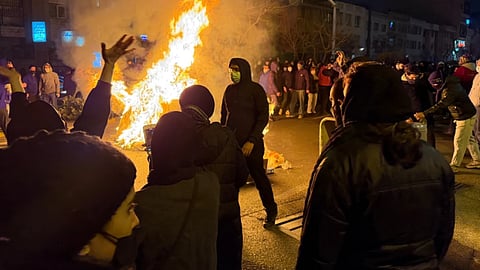

To put the scale of the Iranian regime’s recent massacre of its own people in perspective, consider that more than 1,200 Israelis and foreign nationals were killed in the Hamas-led attack of Oct. 7, 2023. Just under 3,000 people died in the attacks of Sept. 11, 2001. The Battle of Antietam, the bloodiest day in American military history, claimed around 3,600 lives.
A US-based Iranian human rights group says it has verified the killing of more than 5,500 protesters in Iran this month and is still reviewing another 17,000 cases. Many thousands more were injured, and independent reports suggest that tens of thousands have been arrested or arbitrarily detained.
An Iranian doctor in Isfahan told The New York Times of treating “young people whose brains were smashed with live bullets, and a mom who was shot in the neck, her two small children crying in the car; a child whose bladder, hip and rectum were crushed with a bullet.” It is one account among many.
Meanwhile, Iran’s judiciary chief, Gholam-Hossein Mohseni-Ejei, has promised punishment “without the slightest leniency”. Will the world allow him to deliver on that threat?
At this writing, that question confronts the Trump administration. It does not seriously confront the United Nations Security Council, where Iran enjoys diplomatic cover from Moscow and Beijing. Nor does it confront the European Union, which has condemned and sanctioned Tehran but lacks further leverage. Arab leaders, for their part, may prefer a weakened Iran that brutalises its own people to a broken Iran that exports instability — or a liberated Iran that inspires imitation.
Nor, evidently, does it much trouble campus activists and global do-gooders who profess deep concern for Palestinian lives but show little interest in Iranian ones.
That leaves the US to impose meaningful consequences for what ranks among the worst atrocities of this century. President Trump told Axios on Monday that Iran “wants to make a deal” to avert a military strike. Yet Tehran has shown no willingness to meet Washington’s core demands: an end to all independent uranium enrichment, a halt to support for Hezbollah and other proxies, and strict limits on its long-range missile programme.
Iran could soften its stance, if only to buy time. But the odds are rising that the president will order some form of attack once sufficient US forces are positioned in the region — possibly as early as this week. That, in turn, increases the likelihood of Israeli involvement, either in response to Iranian retaliation or through pre-emptive strikes. Either way, this would not be a short, low-cost conflict.
Is the military option wise? The case against it is strong. Iran’s traumatised protesters might have been galvanised by a US strike while they were still in the streets; now they are unlikely to risk their lives again. The regime has learned from Israel’s successful strikes last June against senior commanders and is hiding its leaders more effectively. Israeli attacks on Iran’s ballistic missile sites last year failed to prevent production from resuming once the fighting ended. Even a carefully targeted US strike would feed the regime’s propaganda about American perfidy.
Set against this is a different set of risks: the example of a US president who urged protesters to rise up and promised support, only to abandon them; the loss of an opportunity to weaken an enemy when it is vulnerable, uncertain and internally divided; and the danger of allowing Iran time to recover, knowing that it will again pose a threat to the United States and its allies.
There is also a larger moral question. Do we want to live in a world where figures like Mohseni-Ejei can terrorise citizens with total impunity? Have decades of vows of “Never again” taught us nothing beyond ritual condemnation when thousands of protesters are gunned down by modern-day equivalents of Einsatzgruppen?
It is true that many Americans are currently more focused on domestic outrage — including the killing in Minneapolis on Saturday of Alex Pretti and the smears that followed from senior administration figures. It is also true that a president so culpable for inflaming tensions at home makes an unlikely champion of protesters abroad.
But if Pretti’s death is a tragedy, how should we respond to the murder of thousands of Iranians? Are they, as Stalin once put it, merely statistics?
The New York Times