
- Chennai
- Tamil Nadu
- India
- World
- EntertainmentEntertainment
- Business
- Sports
- Lifestyle
- Technology
- Videos
- Explainers
- Editor's Picks
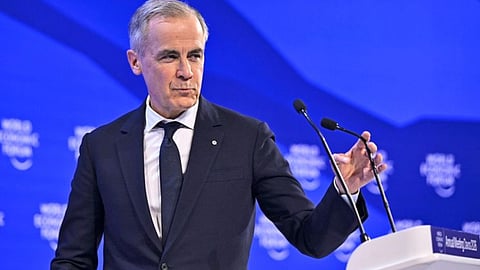
Canadian Prime Minister Mark Carney delivered a stark speech in Davos, Switzerland, on Tuesday, prompting global political and corporate leaders in the audience to rise from their seats for a rare standing ovation.
He described the end of the era underpinned by US hegemony, calling the current phase “a rupture.” He never mentioned President Donald Trump by name, but his reference was clear.
The speech came as Trump doubled down on his threats to take Greenland away from Denmark, saying he would slap fresh tariffs on European powers as punishment for their support of Greenland’s sovereignty.
Global leaders have been scrambling to find a unified response.
“Every day we are reminded that we live in an era of great power rivalry,” Carney said. “That the rules-based order is fading. That the strong do what they can, and the weak suffer what they must.”
And he warned, “The middle powers must act together because if you are not at the table, we’re on the menu.”
He would know.
Trump started his second presidential term making claims on Canada as the 51st state and threatening Canada’s previous leader, Justin Trudeau, with unilaterally scrapping agreements that have governed the relationship between the neighboring countries for more than a century.
He has imposed tariffs on Canada, one of the US’s two top trading partners along with Mexico, that are crippling some of Canada’s key economic sectors, including autos, steel, aluminum and lumber.
Trump’s allies, particularly Steve Bannon, have talked about the benefits of the United States annexing Canada to access its vast Arctic and natural resources, including critical minerals and rare earths.
Carney chastised other leaders, too, many of whom would have been following his speech in Davos, for not standing up for their interests.
“There is a strong tendency for countries to go along to get along,” he said. “To accommodate. To avoid trouble. To hope that compliance will buy safety. It won’t.”
Carney made clear he is choosing a different path.
Carney, a former investment executive who has served as the governor of Canada and England’s central banks, has attended the global gathering about 30 times, according to his office.
Carney spoke not long after Trump had posted an altered image on social media that featured a map of American flags superimposed over both Canada and the United States, as well as Greenland.
Canada’s integration with the US runs deep across its economy, defense and culture.
The position of the country in the ongoing Greenland crisis is distinct from that of the European powers finding themselves in Trump’s crosshairs, even if they are all NATO allies.
Carney has repeatedly said Canada stands squarely behind Greenland and Denmark, but unlike European powers did not send troops to participate in the most recent military exercise. Trump is threatening those nations with fresh tariffs, but not Canada.
On Tuesday, French President Emmanuel Macron echoed Carney, saying that “we do prefer respect to bullies. And we do prefer rule of law to brutality” and decried Trump’s latest tariff threats as an unacceptable “endless accumulation of new tariffs” used as “leverage against territorial sovereignty.”
Canada exports about 75% of its goods and services to the US; its second-largest partner, China, gets less than 5%.
Carney had been trying to strike an agreement with Trump over trade, and the two men appear to enjoy a friendly rapport. Even so, talks are frozen.
A regular review of the free-trade agreement between Canada, the US and Mexico, known as the USMCA, is due this year and its fate is very much up in the air.
Trump has said the US does not need anything that Canada exports, even as the majority of the oil the US imports comes from Canada.
At a moment when the US is led by a capricious and unpredictable president, Canada is trying to break its longtime dependence on the US.
Carney’s speech came at the end of a week on the road with official visits to China and Qatar. Carney struck a deal with China to allow a small number of electric vehicles into Canada at a reduced tariff, breaking with US policy, in exchange for China lowering some tariffs on Canadian agricultural goods.
More important, perhaps, China and Canada declared themselves to be in a “strategic partnership” that signals a new era of cooperation with the United States’ rival for superpower dominance.
The New York Times
