
- Chennai
- Tamil Nadu
- India
- World
- EntertainmentEntertainment
- Business
- Sports
- Lifestyle
- Technology
- Videos
- Explainers
- Editor's Picks
For months, President Trump’s aggressive anti-immigration campaign threatened to push the US to the brink of genuine civil conflict without quite crossing it. The killing of US citizens Renée Good and Alex Pretti by federal immigration officers in Minneapolis has shown that this line can, in fact, be breached.
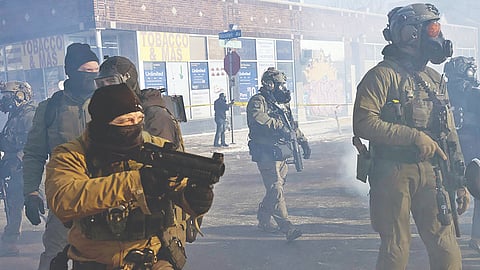
Videos of Immigration and Customs Enforcement (ICE) agents killing Pretti — an intensive-care nurse who was observing and recording a raid — provoked public outrage. Trump responded by briefly striking a conciliatory tone and removing Gregory Bovino, the senior Border Patrol official who had become the public face of the Minneapolis crackdown. Even so, the conflict now playing out on the streets of major American cities is unlikely to abate.
Ironically, this confrontation pits an increasingly authoritarian Republican president against Democratic leaders asserting their constitutional authority. As tensions escalate, governors and mayors in Democratic-controlled jurisdictions find themselves effectively untethered from the federal system meant to restrain executive.
State and local leaders long assumed that close intergovernmental cooperation would temper Trump’s efforts to undermine constitutional rights. But the unleashing of ICE in local jurisdictions, attempts to label Good and Pretti as “domestic terrorists,” and obstruction of state and local investigations into their deaths underscore the administration’s contempt for this foundational feature of American governance.
The standard constitutional remedy for an executive threatening civil breakdown is the separation of powers. In the Trump era, however, both Congress and the Supreme Court have largely abdicated their responsibility to restrain the president or hold him accountable.
As a result, governors and mayors face an agonising dilemma more familiar from great-power politics: how to deter further aggression without provoking. Miscalculation could prompt Trump to invoke the Insurrection Act or, more ominously, to seize control of state capitals through Presidential Emergency Action Documents — classified, Cold War-era authorities designed to ensure continuity of government during a Soviet attack.
This threat, raised repeatedly by Trump in recent weeks, now hangs over state and city leaders like a sword of Damocles. With the establishment of the US Army’s Western Hemisphere Command and a National Security Strategy that elevates homeland and hemispheric security, Trump could deploy federal troops to any US city within hours.
State and local leaders are left with only two viable paths. They can maintain strategic ambiguity about how they would respond to a federal takeover, or they can signal — privately or publicly — that they are prepared to mobilise state and local resources to resist federal overreach. Recent events, from violence in Minnesota to the reckless seizure of Venezuelan President Nicolás Maduro, suggest that dismissing Trump’s radicalism or relying on presumed moral limits is no longer tenable.
Because Trump’s decision-making is driven largely by immediate political calculation and personal aggrandisement, open confrontation would likely invite escalation. The most effective course may be to hedge and prepare for the worst. Governors and mayors should speak publicly about the dangers of executive overreach while continuing to cooperate with federal law enforcement in all areas except immigration.
In that domain, state officials should propose joint operational guidelines for ICE that prohibit the use of tactical gear, masks, heavy weapons and armoured vehicles, and require compliance with accepted policing standards. Such measures would not halt federal action, but they would establish clear norms and strengthen the legal position of states should conflict intensify.
Trump could, of course, ignore these proposals. With that possibility in mind, state and local officials should quietly prepare legal filings for rapid judicial intervention in response to aggressive federal actions, whether undertaken under the Insurrection Act or outside it.
There is no guarantee the courts would intervene. In that event, Congress would remain the only institution capable of checking Trump. Its past acquiescence helped create the current crisis, and with both chambers under Republican control, the militarisation of domestic governance is unlikely to face sustained resistance. This may create a narrow opening for governors and mayors. A congressional awakening may seem improbable, but if Trump invokes the Insurrection Act or similar emergency powers, it may represent America’s last, best hope of averting constitutional breakdown.
