
- Chennai
- Tamil Nadu
- India
- World
- EntertainmentEntertainment
- Business
- Sports
- Lifestyle
- Technology
- Videos
- Explainers
- Editor's Picks
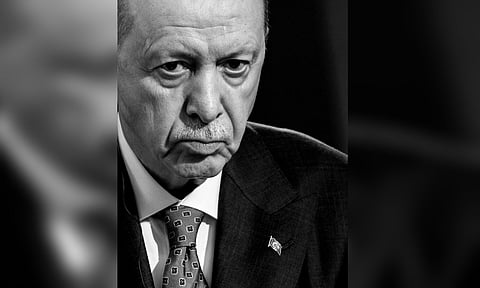
It has been more than two months since the police in Turkey detained Ekrem Imamoglu, the popular mayor of Istanbul and President Recep Tayyip Erdogan’s likely opponent in Turkey’s next presidential election. The international reaction has been largely muted. Turkey is rightly recognised as a geopolitically important — even indispensable — NATO ally, a dominant military power in post-Assad Syria and the natural host to delegations to negotiate peace in Ukraine. If Erdogan, who has long had authoritarian tendencies, is now setting Turkey on the path to full-fledged autocracy, the international community does not seem poised to prevent him.
Nevertheless, he might still fail. In Turkey, the largest protests in a decade and, crucially, the lack of support by important political allies suggest that Mr. Erdogan’s determination to remain in power might have finally pushed him to go too far.
Erdogan has dominated Turkish politics since the early 2000s. For a long time he continued to enjoy popular support, even as he jailed opponents. He continued to consolidate power and, while elections were not fair, the opposition could still win. Last year his Justice and Development Party, or AKP, had a poor showing in municipal elections when disaffected conservative voters, tired of persistently high unemployment and inflation, shifted toward the Republican People’s Party, known as the CHP. Those elections also returned Imamoglu as the mayor of Istanbul for a second term.
Imamoglu’s arrest in March signalled something new: that in elections in Turkey, popular opposition politicians may simply not be allowed to run. Erdogan appeared to be borrowing from the playbook of President Vladimir Putin of Russia. But importantly, since Turkey — unlike Russia — does not possess the natural resources that could help fund autocratic rule, Erdogan is constrained by the need for foreign investment, state support and a majority of the public’s support or at least acquiescence to his actions.
It was immediately clear that the arrest rattled markets — the lira, Turkey’s currency, fell to a record low — and was deeply unpopular with the population. One poll suggested that 65 per cent of people disapproved, and many thousands of people crowded into the streets. A few days after Imamoglu’s arrest, his party conducted a symbolic primary, in which party members and sympathisers anointed the mayor as their candidate for president.
It’s possible that this public anger could give way to apathy before the next elections are scheduled to be held in 2028. Mr. Erdogan may be banking on it. But some of the president’s political allies in the state are signalling that they, too, object.
The far-right Nationalist Movement Party, or MHP, was critical to Erdogan’s re-election as president in 2018 and 2023 and forms part of the AKP’s current parliamentary majority. But a few weeks after Imamoglu’s arrest, Devlet Bahceli, the leader of the MHP, urged a quick resolution. “If he is innocent, he should be released,” Bahceli was reported to have said.
MHP loyalists hold many positions in the state bureaucracy and the judiciary, and the party and Bahceli have been central to the peace process with the Kurdistan Workers’ Party, an insurgent group known by its Kurdish initials, PKK. The disarming and disbanding of the PKK, which the group announced this month, is essential for Turkey’s national security and improved relations with its neighbours, but the arrest of Imamoglu could still imperil this process by undermining the premise that the Kurds will be able to pursue a political solution.
Despite Turkey’s ubiquity on the world stage, it is still geopolitically vulnerable. Russia has historically competed with Turkey for dominance in the Black Sea, the Mediterranean and the Caucasus. But above all, Turkey fears a Kurdish alliance with Israel; Foreign Minister Gideon Saar of Israel has described the Kurdish people as victims of Turkish and Iranian oppression and as Israel’s “natural ally.”
Turkey has a history of turning toward democracy in the face of perceived threats to its national security. In 1950, an authoritarian president, Ismet Inonu, recognised that Turkey, threatened by the Soviet Union, needed to be fully accepted by the West for its own protection. Turkey held multiparty elections, which Inonu lost, and he duly resigned. Decades later, at the turn of this century, a push for membership in the European Union prompted successive Turkish governments to carry out liberal reforms required for its entry.
It’s time for Turkey to turn toward democracy again. Others have recognised this. It’s time for Erdogan to listen.
©️The New York Times Company
