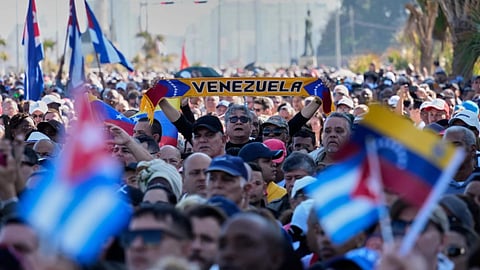

The US conquest of Venezuela and the capture of President Nicolas Maduro and his wife puts paid to the false expectations propagated by the western media that Donald Trump will retire America from its forever wars, bowing to his isolationist support base. It is a sign that Washington’s war lust of 150 years will not only continue, it will intensify. In the first year of Trump’s second term, the US has bombed seven countries—Iran, Iraq, Yemen, Somalia, Syria, Nigeria, and Venezuela—most of which, notably, are either oil-rich or oil-adjacent.
Three strands of Trump’s foreign policy stand out from this brazen invasion.
One is that the US is embarking on unapologetic colonialism. By stating that the US will ‘run’ Venezuela from now on, America is making no secret of its intention to extract that country’s resources for its own energy security. Venezuela holds the world’s largest proven oil reserves of 303 billion barrels, surpassing Saudi Arabia. Right next door are Guyana’s newly discovered offshore reserves. Control of or influence over oil assets across the continent, including those in Mexico and Ecuador, will secure America’s energy security in the foreseeable future.
Plus, Trump has vowed to extract reparations from Venezuela for the losses sustained by American companies due to the nationalisation of the oil industry in that country. This is typical of the 150-year history of corporate colonialism by American companies in Latin America, going back to the ‘banana wars’ fomented by United Foods in Honduras and Nicaragua in the late 19th century and the ‘water war’ perpetrated by Bechtel in Bolivia at the turn of this century.
Second, the Venezuela invasion represents an explicit reassertion of the Monroe Doctrine and the Theodore Roosevelt Corollary by which the US treats the western hemisphere as its exclusive theatre where no competitor can enter. The competing powers were European colonialists when the doctrine was invoked in the 19th century. It is China now, having become, over the past 15 years, the biggest trading partner to several countries on the continent, including Venezuela. It is significant that last week’s invasion was ordered immediately after a high-powered Chinese mission to Caracas.
After the conquest last week, Trump emitted dire signals to Mexico (another major oil producer) and Cuba regarding drug and human trafficking. It is straight out of the CIA playbook to invent a ruse about drug trafficking and set the scene for an intervention. In 1989, the US used the bogey of drug-trafficking to invade Panama, which had been trying to nationalise the Panama Canal, and arrest the dictator, Manuel Noriega. The raid on Caracas was the latest sequel to that invasion.
Thirdly, the Venezuela action is a backhanded admission by America of its inability to compete with China in important high-tech areas. China now dominates the global electric mobility market, producing high-tech vehicles at a fraction of the cost of US manufacturers. In robotics, China has attained mass production with low price tags, undercutting American competitors. In the clean energy sector, it controls over 80% of the solar supply chain and the rare-earth mineral market. By reverting to gunboat diplomacy to secure fossil fuel assets, Washington is effectively acknowledging that it cannot out-innovate Beijing in emerging sectors nor match its cost efficiency in manufacturing mass goods. This, in fact, could be the last throw of the dice.