
The utter incompetence of multiple civic agencies in saving a drowning man in the heart of Greater Noida last week throws light on an effete state that is simply unable to summon up the will to serve its citizens.
Yuvraj Mehta’s desperate cries for help from atop his sinking car, and the lack of capacity as well as courage among rescue personnel on the shore amid a fog enveloping the dreadful night make for a depressing picture of India under the current dispensation.
The man, 27-year-old Yuvraj Mehta, was driving back home under poor visibility conditions at midnight Friday, January 16, when his SUV plunged into a 50-ft flooded construction site that had neither a protective barrier nor warning signage. Mehta survived the initial fall and climbed onto the roof of his sinking car.
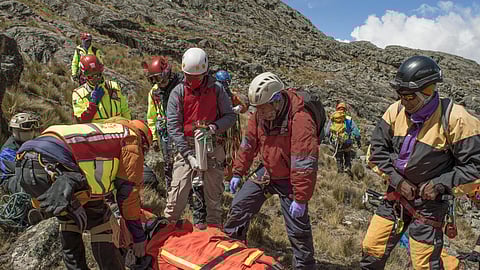
For nearly 90 minutes, he desperately signalled for help using his mobile phone’s torch and spoke to his father on the phone, who rushed to the site. Rescue personnel from four agencies—the Noida civic authority, the fire brigade, police and the National Disaster Response Force – assembled on the shore but quibbled over the conditions, the equipment, the method and even the temperature of the water as the car went under the water, taking the young man with it.
The case has sparked nationwide outrage after the naked truth of the lack of prowess of our emergency services played out for everyone to see. Supposedly, trained rescue personnel refused to enter the water because the water was cold and feared the presence of iron rods under water. They lacked the thermal gear to operate at 30-foot depth and the fog lights needed to work in darkness.
Even in terms of derring-do, they were shown up by a local delivery agent who jumped in to help with a rope tied around his waist. But by then, the vehicle had submerged and Mehta had succumbed to asphyxiation and cardiac arrest.
This tragedy highlights failure at multiple levels, a many-headed failure that shows up at every crisis and in every disaster, be it a stampede at a crowded event, an outbreak of fire at an establishment with no safety arrangements, and the all-too-common and annual bouts of urban flooding in multiple cities.
In the crisis management aspect, we have been witness to poorly trained and poorly equipped responders, as was glaringly evident in Greater Noida last week. But also, we see all too often contributory failings in the form of derelict safety regulation and administration. It’s a shame that basic safety measures such as cautionary signage, working streetlights, and concrete barricading were absent on the street on which Yuvraj Mehta met his death.
The fact that these were the conditions in the streets of a much-touted urban area is the least of it. Badly contoured lakesides and open excavation pits are universal conditions in the cities of India. Municipalities ignore them and local people normalise them, converting them into death traps.
Yuvraj Mehta’s death must jolt civic administrations and rescue agencies to overhaul their training methods, response protocols and equipment. There’s no joy in staffing rescue agencies with personnel lacking the basic skills and minimum bravery. At the very least, every municipality must have rescue units of its own equipped with boats, rafts and amphibious machinery.