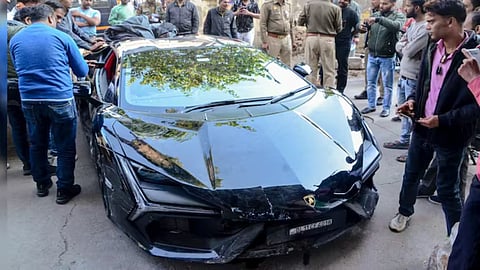

A disturbing pattern is emerging in recent years in which high-speed luxury cars are becoming a threat to life and limb of innocent people and the law enforcement authorities – and even lower judiciary – are found lacking in taking deterrent legal action.
In the latest episode, the 26-year-old scion of a wealthy business family in Kanpur was allegedly involved in a high-speed crash in which several persons sustained injuries. It took four days for the police to take him into custody – and it took him only hours to get bail from a local court, which declined to grant remand. After public outcry and social media outrage, disciplinary action was initiated against a local police official for alleged procedural lapses.
In accidents involving the affluent, a distressing aspect is drivers belonging to economically disadvantaged sections of the society coming forward to own the responsibility. By design or otherwise, the system tends to work in favour of the rich through manipulation and clever use of loopholes. In many cases, this makes it nearly impossible to successfully prosecute and bring the culprits to justice. This seems to be giving the rich the confidence and license to be callous and reckless.
In the recent years, uber rich Indians have been acquiring high-speed supercars as a symbol of affluence, social status, and as a marker that distinguishes them not only from the hoi polloi but especially the upwardly mobile upper middle class. The problem is that these mechanical beasts, with powerful engines that have the capability to accelerate rapidly and clock top speeds of over 300 km/h, are not suited for Indian city roads and most highways.
Overspeeding is one of the main reasons for fatal and serious accidents, which stems from from an arrogant disdain for rule of law and the confidence of “managing” or preempting the legal consequences with money power. Many accidents are reportedly due to poor training, which is exacerbated by consumption of alcohol. The tragic irony is that the occupants of luxury cars are relatively safer as they are protected by the in-built safety systems, while pedestrians, bike riders and occupants of low-end cars are exposed to grave dangers in the event of an incident.
Indeed, there are automobile accidents in advanced Western countries with great transport infrastructure and relatively rigorous training systems. But more often than not, they are due to collision with other vehicles or fixed objects, while pedestrians and bike riders account for a majority of road crash fatalities in India.
According to the government, the maximum design speed specified for highways is 100 km/h and for expressways 120 km/h. Hardly any long stretch of city roads can support high speeds in a safe manner, even when driven by alert and experienced drivers. The government must seriously consider ordering installation of speed governors or speed limiters in these cars.
Also, a more stringent system for issuing licenses to drive fast cars should be considered, but getting the notoriously corrupt RTO staff to implement it rigorously will be a challenge. Lastly, police and lower court officials should be sensitised about the need to be firm and fair and resist direct or indirect pressures to adopt a soft approach towards the accused from the affluent class. The systemic bias and the unholy nexus between money power and pliable authorities tend to short circuit all safeguards.