
- Chennai
- Tamil Nadu
- India
- World
- EntertainmentEntertainment
- Business
- Sports
- Lifestyle
- Technology
- Videos
- Explainers
- Editor's Picks
It needs no guessing who the orchestrator is when, in the space of three days, governors in three southern states act similarly to embarrass their respective governments on the floor of the legislature. The Centre’s representatives in Tamil Nadu, Karnataka, and Kerala this week either refused to read or heavily altered the government-prepared text while delivering their address to the Assembly.
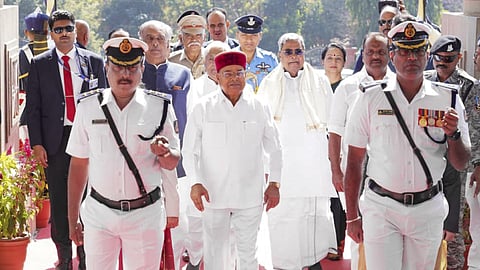
On Thursday, January 22, Karnataka Governor Thaawarchand Gehlot made a mockery of the occasion by reading only the first and last lines of the text prepared by the state government. His excuse was that 11 paragraphs in the text criticising the Union government for repealing the Mahatma Gandhi National Rural Employment Guarantee Act were not palatable to him.
On Tuesday, Jan. 20, Tamil Nadu Governor RN Ravi walked out of the Assembly, for the third consecutive year, without delivering his customary address to the legislature, taking issue with some of the claims made in the text prepared by the DMK government. He also found fault with the order of the anthems played before the session.
That same day, Kerala Governor RV Arlekar did deign to read out the official policy address but made extensive unilateral edits and deletions, omitting sections critical of the Union government for heaping woes upon the state government.
These are but the latest tactics adopted by the governors, at the apparent behest of the Centre, to frustrate state governments in the South where the BJP has been unable to establish a permanent foothold. The purpose is to hinder or slow down governance by raising officious queries, withholding assent to bills, and holding up appointments— all the while stoking needless cultural controversies to assist the agenda of the BJP.
In Tamil Nadu, the DMK government had to approach the Supreme Court when Governor Ravi sat on 10 legislative bills, some since 2020, and meddled with appointments, including to vice-chancellor (VC) posts in three major universities. Despite favourable rulings, the government has had to take the long way round the bottlenecks and barriers set up in its path. Taking a cue from the BJP’s gubernatorial playbook, Ravi insisted that the National Anthem be played at the start of the Assembly session despite the state’s convention being to play the Tamil anthem at the start and the National Anthem at the end.
In Kerala, 14 bills await assent as Governor Arlekar continues the confrontationist attitude adopted by his predecessor, Arif Mohammed Khan, who left a bitter legacy by dismissing government-appointed VCs and unilaterally appointing his own nominees.
The obstructionist attitude of governors is forcing state governments to repeatedly seek the Supreme Court’s intervention to rule on a basic tenet of the Constitution, that the governor shall act as per the advice of the Cabinet. Conventionally, the governor’s address to the legislature lays out the government’s policy and therefore must reflect its priorities. In the present case in Karnataka, the government has every right to place on record its fiscal difficulties due to the replacement of the MGNREGA, which was fully Centre-funded, with the VB-Gram G scheme, which transfers some of the burden to the state. If thwarted by the governor, the governments have no option but to read out the redacted parts so that the legislative record bears them out.
