
- Chennai
- Tamil Nadu
- India
- World
- EntertainmentEntertainment
- Business
- Sports
- Lifestyle
- Technology
- Videos
- Explainers
- Editor's Picks
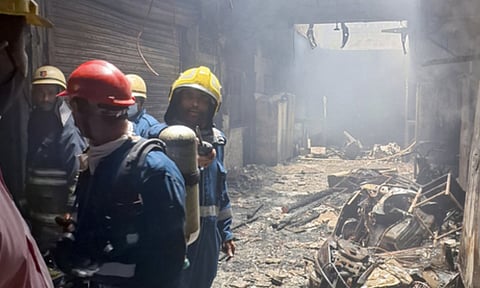
♦ Many Indian cities and towns have been veritable tinderboxes. Every now and then, a catastrophic fire accident would hit the national headlines, sometimes igniting public outrage and debate. Often nothing comes of it, though. In the summer season, there are more fire hazards due to dry and inflammable conditions and a surge in electricity consumption resulting in overloads. For instance, in the last few days, there have been a number of fire accidents. Fire ravaged a century-old building near Charminar in Hyderabad, which was a shop-cum-residence and killed 17 persons across three generations of a jeweller’s family. In Uttar Pradesh's Budaun, a sweeping blaze gutted about 200 houses and a factory.
Down south, Kozhikode Muffosil bus stand was the scene of a fire accident, which reportedly began in a textile shop. These often occur in crowded and unplanned residential and commercial establishments, and densely populated localities in older parts of the city. Recently, there were accidents in hazardous factories and illegal fireworks factories in Gujarat and West Bengal.
In India, nearly 50 per cent of fire accidents occur in residential buildings, and consequently, more women die in fire accidents. Nearly half of the accidents occurred in a handful of states, and prominent among them were Maharashtra, Madhya Pradesh and Gujarat. There are distressingly repetitive patterns to and causes for fire accidents. Electrical faults and short-circuits are often the main reason.
Similarly, places that store highly combustible materials are prone to devastating fire accidents, which are difficult to suppress swiftly. Older buildings with narrow entrances and exits, and which are located in cramped localities with cluttered streets, report extensive damage to property and higher casualty figures. Even modern high-rise buildings were often found to be lacking in fire prevention alarms and fire-fighting systems such as hand-held extinguishers and sprinklers. Both old buildings and high-rise buildings pose problems in evacuation and suppression of fires as fire tenders can’t arrive on time and operate with ease.
There are some systemic problems, too. Firstly, though India has a National Building Code which incorporates fire safety norms, they are not complied with by either older buildings or new buildings.
Corrupt officials, often backed by political players, are often found complicit in their non-compliance.
Secondly, poor urban planning results in congested roads and buildings. When it comes to older areas, local administrations do not take steps to decongest the area through relocation. Chennai has been successful in the case of a vegetable and fruit wholesale market despite stiff resistance from the stakeholders. It shows that with the required political backing and administrative will, it could be done. Lastly, enforcement of electrical safety standards relating to BIS-certified electrical equipment, evenly distributed loads, and faultless wiring insulation leaves much to be desired.
Besides fixing the above issues on a war footing, state governments should also focus on the modernisation of fire services. For instance, fire stations in areas with high-rise buildings should have hydraulic platforms and turntable ladders and trained firefighters to operate them. The central government too needs to pitch in, not only with financial support but also in creating fire safety awareness among citizens. Local bodies should periodically conduct surprise and rigorous fire audits and inspections.
Without a multi-agency, multi-pronged strategy, India cannot hope to achieve fire safety’s “zero death” goal.
