
- Chennai
- Election-2026Election-2026
- Tamil Nadu
- National
- World
- Cinema
- Business
- Sports
- Lifestyle
- Technology
- Videos
- Explainers
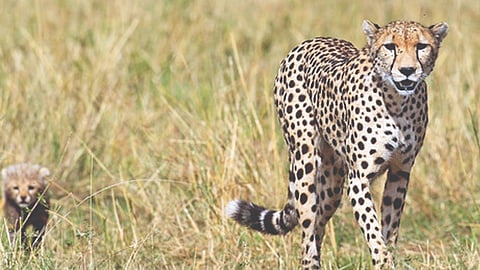
India continues to pursue the Cheetah Reintroduction Project despite some initial setbacks and continued criticism from well-meaning quarters. Union Minister for Environment and Forest Bhupender Yadav and Madhya Pradesh Chief Minister Mohan Yadav have announced separately that eight cheetahs would be translocated from Botswana to Kuno National Park. During President Droupadi Murmu’s visit last November, Botswana gifted these eight cheetahs to India. The Indian President mentioned that good care will be taken of them.
Project Cheetah was launched with fanfare and a high-visibility media campaign. In September 2022, Prime Minister Narendra Modi released the first eight cheetahs, which were part of the 20 cheetahs that were brought from South Africa and Namibia. The results have been mixed. Some of the cheetahs gave birth to cubs in India, but there were also some deaths of adult animals and cubs. The South African government took cognisance of the deaths, which it said were “unjustified”, and ordered a comprehensive review of the project. India, however, described the South African action as part of due diligence. Subsequently, India began to look at other nations like Botswana and Kenya for sourcing the carnivores.
Translocating animals from another continent is fraught with danger. The government is said to have conducted extensive consultations with international domain experts, veterinarians and scientists. It also had a steering committee to review, monitor and guide the project. Yet there were casualties, which the government averred to the Supreme Court were not “unduly alarming”. However, experts have been warning about the dangers of introducing large carnivores into foreign habitats, even if care had been taken to ensure somewhat similar habitats for them. Secondly, large carnivores can survive and flourish if there is a supportive ecosystem in terms of conducive terrain and livestock as a sustainable prey base. Thirdly, world-class conservation expertise and committed, trained and experienced human resources on the ground are essential for ensuring effective implementation. Whether the government concedes or not, it is evident that there were gaps and shortcomings in the above.
By adopting a holistic approach, Project Tiger became an international success story. Its strategy involved the creation of dedicated tiger reserves, planned habitat management, the use of new and emerging technology for monitoring, and putting in place a protection force to curb poaching. The successful project gave India an enviable track record to boast of when it comes to wildlife conservation. Started in 1973, in half a century, there has been tremendous progress, and India has emerged as a home to over 70% of the world’s wild tigers. Project Cheetah could replicate the success of Project Tiger if it adopts scientific methods. Equally important, as the Supreme Court observed, it should be treated as a conservation project and not a “prestige” project. Keeping the focus on conservation and animal well-being will prevent or minimise avoidable losses.
Lately, thanks to the corrective steps taken by the government, there has been a marked improvement in the survival rate of not only adult cheetahs translocated from abroad but also of cubs that were born in India. With the Kuno sanctuary reaching a saturation point, the government is looking at other sites, such as Gandhi Sagar Wildlife Sanctuary and planned expansion to Noradehi and Banni Grasslands. Authorities, hopefully, will take steps to avert casualties at the new sites.