
- Chennai
- Tamil Nadu
- India
- World
- EntertainmentEntertainment
- Business
- Sports
- Lifestyle
- Technology
- Videos
- Explainers
- Editor's Picks

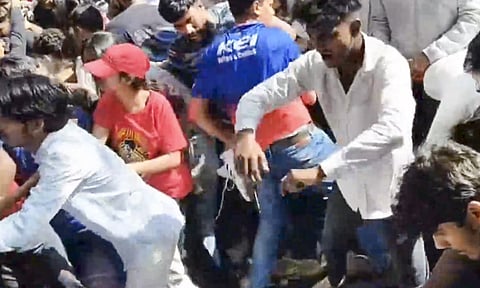
CHENNAI: It takes little for a crowd to collect in India, and stampedes are all too frequent. Given such a propensity, it’s a shame that our authorities repeatedly fail to assess risk and be alert to adverse triggers at crowd events. The tragic crush at the Chinnaswamy Stadium in Bengaluru on Wednesday, which took the lives of 11 people, is a textbook case of important stakeholders being negligent in applying the minimum principles of safety while organising a mass celebration.
The stampede took place at the gates of the stadium where the Royal Challengers Bengaluru (RCB) team organised a celebration of its victory in the IPL competition. The team won the final late Tuesday evening, June 3, triggering wild jubilation by fans, which required the police to be up and about to keep order.
Shockingly, the team management decided to organise a mass celebration and a victory parade of its cricket stars the very next day, which left no time for the police to make arrangements for crowd control. And then, someone in the state government decided to jump on the bandwagon and added a felicitation by the Chief Minister on the steps of the Vidhana Soudha to round off the revelry.
Clearly, exuberance got the better of good judgement. Ignoring the risks involved, the management tweeted open invitations to the parade. The law-and-order authorities seemed to be unsure about the scale and schedule of the events and were certainly unprepared. The police ought to have put their foot down at this stage and refused to go along willy-nilly. They did not, perhaps because the political establishment seemed to have become invested in the feel-good opportunity.
As even a novice knows, nothing attracts a crowd in India like religion, films and cricket, and a crush of two lakh people massed at the gates of Chinnaswamy (capacity 30 lakh). As the celebrations inside got going, the narrow gates gave in to the press and pell-mell ensued. Policemen were simply overwhelmed.
Compare this to how the city of Liverpool managed its team’s victory in the Premier League in England last month. There, too, the victory parade took place the day after the final game in the championship. But the difference was that Liverpool had established an unbeatable lead in the league a month prior, and the city council and team management collaborated over four weeks to organise the celebration, planning the route, the scale and the timing down to finer details.
The Bengaluru tragedy shows how crowd management has not evolved in India despite the repeated occurrence of stampedes. In just the last year, tragic shortcomings in mass event management were exposed at Shirgao, Goa (May 3), the New Delhi Railway Station (Feb. 15), Prayagraj, UP (Jan. 29), Tirupati, (Jan. 8), Hyderabad (Dec. 4), and Hathras, UP (July 2), 2024), taking a cumulative toll of 162 lives.
The factors common to these tragedies were (1) crowds more than capacity, (2) poor crowd management and planning, (3) scarcity psychology in the crowd, and (4) fervour focused on religion/film star/sport star. Despite recurring patterns, it's a pity we have not yet vested our authorities with a typology of crowd risks, adverse triggers and response protocols, as recommended by the NDRF 11 years ago. As long as we approach crowd management as mere bandobust, not a high-tech and highly skilled discipline, we will continue to see celebrations turn into tragedy.