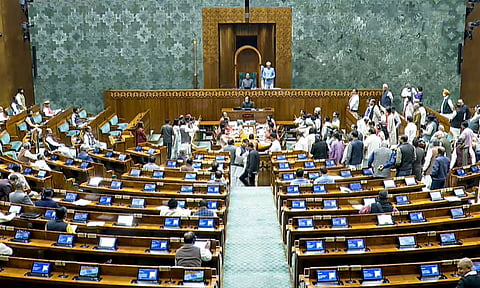

The Union Government this week passed in the Lok Sabha a bill to replace the MGNREGA scheme (Mahatma Gandhi National Rural Employment Guarantee Act), which gives unemployed manual labourers the right to work. The new bill has the prosaic name Viksit Bharat Guarantee for Rozgar and Ajeevika Mission (Gramin) Bill, 2025 and abbreviates as VB-G RAM G. While the new nomenclature is a bid to erase the name of the Father of the Nation as well as the good work of the UPA-1 government, the provisions of the bill will only hollow out a scheme that has been the last resort of the poorest people for 20 years.
The Sangh Parivar’s desire to remove Mahatma Gandhi from the memory of the people is no secret. It is central to its Hindu Rashtra project. Gandhi stands as a barrier to the BJP’s dream of ethno-nationalism. This renaming of a perfectly sensible and successful government scheme is another bid to go around it. Despite such moves, it must be frustrating to the busy minds of this regime that they have to bow their heads at Rajghat every now and then.
From a substantive perspective, this legislation spells the end of the right to work that is central to the MGNREGA. It dismantles a legal guarantee by which a worker could demand work, and the government was bound to oblige him or her. Also, the new bill allows the Union Government to predetermine the allocation of funds for each state and specify where and what kind of work must be taken up. This robs village panchayats and state governments of the operational powers that made MGNREGA responsive to local needs and hence successful. It does raise, from 100 to 125, the minimum number of days of work that must be made available to beneficiaries, but that really is a gift given with one hand and taken away with another. With allocations preset, work cannot expand as per the local need. It would have to stay within the tight tramlines drawn by the Centre.
New Delhi is also seeking to ease itself of the burden of having to bear 100% of the wage cost of the scheme. The funding ratio between the Centre and the states is fixed at 60:40, covering wages and cost of material. This would be an unbearable burden for debt-ridden states like Andhra Pradesh, Telangana and Kerala, or even those like Karnataka and Tamil Nadu that are revenue-strapped due to the GST regime. Due to the higher number of mandatory minimum work days and the limited funds available, the scheme will benefit fewer workers.
The new bill also claims to be responsive to farmers by including a 60-day pause for the scheme during the peak agricultural season when there is a shortage of farm workers. This is an oft-heard but unfair plaint against MGNREGA. While studies have reported that labour costs to farmers have risen due to MGNREGA, it is important to remember two things: one, that the very purpose of the scheme was to shore up a wage baseline for farm workers, especially women; and two, that labourers are harder to get during the peak season not only because of MGNREGA but also due to the availability of higher-paying work in the cities like construction.