
Arundhati Roy
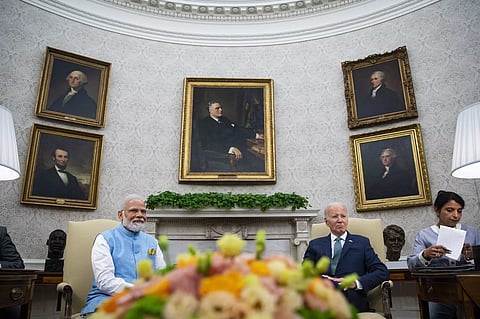
The state visit by Prime Minister Narendra Modi of India to Washington last month was billed as a meeting of leaders of two of the world’s greatest democracies, and the countries duly declared themselves “among the closest partners in the world.” But what sort of partners will they be? What sort of partners can they be? President Biden claims that the “defense of democracy” is the central tenet of his administration. That’s commendable, but what happened in Washington was the exact opposite. The man Americans openly fawned over has systematically undermined India’s democracy. We needn’t be shocked by America’s choice of friends. The enchanting folks that the US government has cultivated as partners include the shah of Iran, Gen. Mohammad Zia ul-Haq of Pakistan, the Afghan mujahideen, Saddam Hussein of Iraq, a series of tin-pot dictators in South Vietnam and Gen. Augusto Pinochet of Chile. A central tenet of US foreign policy has, too often, been democracy for the United States, dictatorship for its (non-white) friends.
Modi certainly does not belong in that rogues’ gallery. India is bigger than him. It will see him off. The question is: When? And at what cost? India is not a dictatorship, but neither is it still a democracy. Modi heads a majoritarian, Hindu-supremacist, electoral autocracy that is tightening its grip on one of the most diverse countries in the world. This makes election season, which is just around the corner, our most dangerous time. It’s murder season, lynching season, dog whistle season. The partner that the US government is cultivating and empowering is one of the most dangerous people in the world — dangerous not as a person but as someone turning the world’s most populous country into a tinderbox. What kind of democrat is a prime minister who almost never holds a news conference? It took all of the US government’s powers of persuasion (such as they are) to coax Modi into addressing one while in Washington. He agreed to take two questions, only one of them from a US journalist. Sabrina Siddiqui, The Wall Street Journal’s White House reporter, stood up to ask him what his government was doing to prevent discrimination against minorities, particularly Muslims. Given the worsening abuses against Muslims and Christians in his country, it’s a question that really ought to have been raised by the White House. But the Biden administration outsourced it to a journalist. In India, we held our breath. Modi expressed surprise that such a question should be asked at all. Then he laid out all the bromide that he had brought along in his baggage. “Democracy is our spirit. Democracy runs in our veins. We live democracy.” He added, “There’s absolutely no discrimination.” And so on.
In India the mainstream media and Modi’s vast fan base reacted as though he had hit the ball clean out of the park. Those who oppose him were left sorting through the debris for shreds of reassurance. (“Did you notice Biden’s body language? Totally hostile.” And so on.) I was grateful for the hypocrisy. Imagine if Modi had felt confident enough to tell the truth. Hypocrisy gives us a sort of ragged, shabby shelter. For now, it’s all we have.
Mercilessly attacked by the ruling Bharatiya Janata Party’s cheerleaders and other Hindu nationalists on Twitter, Siddiqui was accused of being a biased Pakistani Islamist hate-monger with an anti-India agenda. Those were the more polite comments. Eventually the White House had to step up and condemn the harassment as “antithetical to the very principles of democracy.” It felt as if everything that the White House had sought to gloss over had become embarrassingly manifest. Siddiqui may not have anticipated what she walked into. The same cannot be said of the State Department and the White House. They would have known plenty about the man for whom they were rolling out the red carpet.
They would have known about the role Modi is accused of having played in the 2002 anti-Muslim pogrom in the state of Gujarat, in which more than 1,000 Muslims were killed. They would have known about the sickening regularity with which Muslims are being publicly lynched, about the member of Modi’s cabinet who met some lynchers with garlands and about the precipitous process of Muslim segregation and ghettoisation.
They would have known about the hounding of opposition politicians, students, human rights activists, lawyers and journalists, some of whom have received long prison sentences; the attacks on universities by the police and people suspected of being Hindu nationalists; the rewriting of history textbooks; the banning of films; the shutdown of Amnesty International India; the raid on the India offices of the BBC; the activists, journalists and government critics being placed on mysterious no-fly lists; and the pressure on academics, both Indian and foreign.
They would have known that India now ranks 161st out of 180 countries on the World Press Freedom Index, that many of the best Indian journalists have been hounded out of the mainstream media and that journalists could soon be subjected to a censorial regulatory regime in which a government-appointed body will have the power to decide whether media reports and commentary about the government are fake or misleading.
They would have known about the situation in Kashmir, which beginning in 2019 was subjected to a months-long communication blackout — the longest internet shutdown in a democracy — and whose journalists suffer harassment, arrest and interrogation. Nobody in the 21st century should have to live as they do, with a boot on their throats.
They would have known about the Citizenship Amendment Act, passed in 2019, which barefacedly discriminates against Muslims; the massive protests that it touched off; and how those protests ended only after dozens of Muslims were killed the following year by Hindu mobs in Delhi (which, incidentally, took place while President Donald Trump was in town on a state visit and about which he uttered not a word).
The Biden administration would have also known that every moment of the grand reception and every episode of bogus flattery will be spun into pure gold for Modi’s 2024 election campaign, in which he is seeking a third term. What kind of an ally will the United States be to India in the event of a confrontation with China? The United States is far from the potential battlefield. The only price it might pay if things go badly is a bloody nose and a last helicopter ride out of the war zone as collaborators hang on to its landing skids. We need only look around our neighborhood at the fate of America’s old friends Afghanistan and Pakistan. A bad moon is rising in the South China Sea. But for India, its friends and enemies are all wrapped up together in a tight ball of wax. We should be extremely, exceedingly, exceptionally, extraordinarily careful where we place our feet and float our boats. Everybody should.