
- Chennai
- Tamil Nadu
- India
- World
- EntertainmentEntertainment
- Business
- Sports
- Lifestyle
- Technology
- Videos
- Explainers
- Editor's Picks
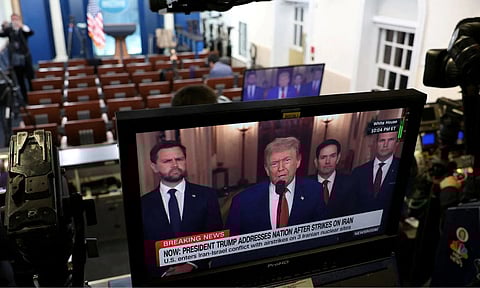
The strike on three of Iran’s nuclear facilities by the United States was unwise and unnecessary. Now that it’s done, I very much hope it succeeded.
That’s the paradox for many former officials like me who worked on the Iran nuclear problem during previous administrations. We shared a determination that Iran would never be allowed to produce or possess a nuclear weapon. Iran without a nuclear weapon is bad enough: a leading state sponsor of terrorism; a destructive and destabilising force via its proxies in Lebanon, Syria, Gaza, Yemen and Iraq; and an existential threat to Israel. An Iran with a nuclear weapon would feel emboldened to act with even greater impunity in each of those arenas.
So why was the strike a mistake?
First, it never should have come to this. In 2015, the Obama administration, together with Britain, France, Germany, Russia, China and the European Union, reached an agreement with Tehran on the Joint Comprehensive Plan of Action, or JCPOA. The nuclear deal effectively put Iran’s program to make fissile material, the fuel for a nuclear weapon, in a lockbox, with stringent procedures for monitoring the program. The deal pushed “breakout” — the amount of time it would take Iran to produce enough weapons-grade uranium for a single nuclear weapon — to at least one year. If Iran reneged on the agreement or refused to extend it when certain provisions expired after 15 years, we would know it and have plenty of time to respond, including, if necessary, militarily.
In 2018, President Trump tore up the agreement and replaced it with … nothing. In response, Iran accelerated its enrichment, quite likely reducing its breakout time to a matter of days or weeks. Trump, in essence, is now trying to put out a fire which he poured gasoline on.
Second, fissile material is a necessary but insufficient element for a bomb. You also need an explosive weapon. As of now — and there are conflicting messages coming from within the Trump administration — our intelligence agencies believe Iran has not yet decided to weaponise. If and when it does, it would take Tehran 18 to 24 months to produce an explosive device, according to some estimates. In other words, there was still time for diplomacy to work, and the situation wasn’t nearly the emergency that Trump portrayed.
Third, experts I’ve spoken to had real doubts about the ability of the Massive Ordnance Penetrator, or MOP — the 30,000-pound bombs unique to America’s arsenal that were dropped on Iran’s nuclear sites — to fully incapacitate the Fordow site and other deeply buried or fortified components of Iran’s nuclear program. Initial reports suggest that while Iran’s nuclear infrastructure was severely damaged, it was not destroyed.
Fourth, in war-gaming the military option during my time in the Biden administration, we were also concerned that Iran had or would spread its stockpile of uranium already enriched to just short of weapons-grade to various secure sites and preserve enough centrifuges to enrich further that stockpile in short order. In that scenario, the Iranian regime could hide its near weapons-grade material, green-light weaponisation and sprint toward a bomb. Thus, Trump’s strike has risked precipitating what we want to prevent. This may prove a repeat of Israel’s strike against Iraq’s Osirak reactor in 1981 — after the strike, Saddam Hussein accelerated an underground program.
Finally, while there is no doubt the American strike set back Iran’s nuclear ambitions, Iran could rebuild quickly, in locations and at depths virtually immune to airstrikes, while pursuing weaponisation at the same time. So while their programme has been significantly disrupted, and buying time is a good thing, it underscores that sticking with the JCPOA was the better option. It bought us at least 15 years instead of just a few. And it avoided the risk of Iranian retaliation — such as Monday’s missile attacks directed at our forces in the region — as well as the potential for further escalation, including threatening global oil flows through the Strait of Hormuz, conducting terrorist operations on American soil or carrying out sophisticated cyberattacks.
Perhaps paradoxically, Trump’s actions were possible only because of the work of the Obama and Biden administrations.
The Obama administration accelerated the development of the MOP and had contingency plans for the type of operation that Trump authorised. Biden instructed his team to rehearse, test and refine those plans. We also conducted, in 2023, the largest-ever joint exercise with Israel — something of a dry run for this latest action.
As importantly, Biden supported Israel’s successful efforts to grievously weaken Iran and its proxies. Our deployments, deterrence and active defence of Israel when Iran directly attacked it for the first time allowed Israel to degrade Iran’s proxies and its air defences without a wider war. In so doing, we set the table for Trump to negotiate the new nuclear deal he pledged years ago to work toward — or to strike. I wish that he had played out the diplomatic hand we left him. Now that the military die has been cast, I can only hope that we inflicted maximum damage — damage that gives the president the leverage he needs to finally deliver the deal he has so far failed to achieve.
Antony J Blinken was the secretary of state under President Joe Biden
©️The New York Times Company
