
- Chennai
- Tamil Nadu
- India
- World
- EntertainmentEntertainment
- Business
- Sports
- Lifestyle
- Technology
- Videos
- Explainers
- Editor's Picks
NEW YORK: For decades, astronomers have been observing WOH G64, a massive star in the Large Magellanic Cloud, a galaxy visible to the naked eye from the Southern Hemisphere.
The star is more than 1,500 times larger than the Sun and emits over 100,000 times more energy. For long, the red supergiant appeared to be steadily nearing the end of its life, shedding material and swelling in size as it ran out of fuel.
Astronomers did not expect its final demise anytime soon, as no known red supergiant has ever been seen dying. But in recent years, astronomers — including teams working with the Southern African Large Telescope (SALT) — discovered that the star has begun changing.
It has grown dimmer and appears warmer, surprising scientists and suggesting that the final stages of massive stars may be more complex and possibly faster than previously thought.
Massive stars, more than eight times the mass of the Sun, produce enormous energy and exhaust their fuel within millions of years, unlike the Sun’s lifespan of billions of years.
Most massive stars become red supergiants during their final million years. These stars eject strong gaseous winds, losing mass in the process. In some cases, the expelled material forms a surrounding shroud of gas and dust, making the star appear dim in visible light but bright in infrared wavelengths.
WOH G64 was first catalogued in the 1960s by Swedish astronomers Westerlund, Olander and Hedin, who considered it an ordinary red giant. Later, in the 1980s, data from the InfraRed Astronomical Satellite revealed it to be the most luminous, coolest and dustiest red supergiant in the Large Magellanic Cloud, which contains more than a thousand such stars.
Observations over the following decades showed steady brightness variations typical of pulsating red supergiants.
In 2024, astronomers captured an unprecedented close-up image of WOH G64 using telescopes of the European Southern Observatory. The image revealed a fresh dust cloud close to the star, the sharpest picture of a star in another galaxy ever taken. Scientists found that the star had begun ejecting significantly more dust in the past decade, though the cause remained unclear.
During the same period, the star dimmed, possibly due to the dust cloud, and its pulsations slowed slightly while becoming faster in rhythm, indicating that it may have shrunk. The star also appeared warmer, leading to speculation that it might have entered a new evolutionary stage called a yellow hypergiant.
Recent observations using SALT have provided further clues. The data showed strong presence of ions near the star, indicating very hot gas. At the same time, astronomers detected molecular signatures that indicate cooler gas within the star’s atmosphere. These findings suggest that WOH G64 has not yet transitioned into a yellow hypergiant.
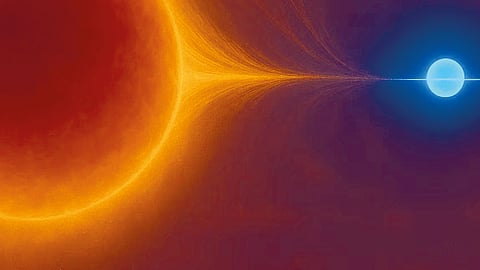
Astronomers have long suspected that the red supergiant may have a smaller, hotter companion star.
The hotter star could be heating gas captured from the red supergiant’s wind, making the heated gas more visible as the larger star fades.
If the companion star moves farther away again, WOH G64 might regain some of its earlier characteristics. Alternatively, it may shed its outer layers entirely, removing dust and revealing its inner structure. The star could also behave in entirely unexpected ways, reminding astronomers that stellar evolution still holds many mysteries.
