
- Chennai
- Election-2026Election-2026
- Tamil Nadu
- National
- World
- Cinema
- Business
- Sports
- Lifestyle
- Technology
- Videos
- Explainers
The Taj Mahal, India’s most famous landmark, is haunted by a conspiracy theory pushed by pseudo-historians, lawyers and religious activists who claim that everything you’ve been told about the building is a lie.
The theory is convoluted that the monument is not a 17th-century Indo-Islamic architectural masterpiece commissioned by Mughal emperor Shah Jahan as a tomb for his wife, who died giving birth to their 14th child. Instead, has suppressed Hindu origins.
The assertions rely largely on conjecture and have repeatedly been debunked. Yet they persist. Hari Shankhar Jain, a prominent advocate of the theory, said authorities “did not want the truth to come out.”
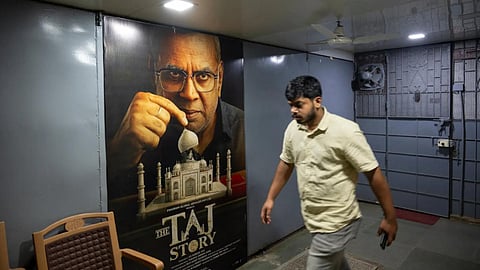
Now, Bollywood has amplified those claims. A new film, The Taj Story, turns the revisionist narrative into a courtroom drama starring Paresh Rawal. Promotional material promises to “reveal the untold history” of the monument. Instead, the film revisits discredited theories once confined largely to fringe internet discussions, giving them mainstream visibility.
Among the claims presented are that the Taj Mahal site was originally a Hindu palace or temple dedicated to Lord Shiva; that carbon dating of wood from one of its doors suggests construction predates the Mughal period; and that 22 “secret chambers” beneath the structure were sealed by authorities to conceal evidence.
The film’s writer and director, Tushar Amrish Goel, said he spent two-and-a-half years researching alternative theories about the monument’s origins, describing them as “intriguing and engaging”. The story follows a veteran Taj Mahal tour guide who begins questioning historical narratives and approaches the courts seeking validation.
“We just put our argument in the courtroom,” Goel, 35, said in an interview in Mumbai.
Released in late October, the film reflects how popular culture can move conspiracy theories into mainstream discourse, mirroring broader distrust of established historical narratives. Observers have compared it to Oliver Stone’s 1991 film JFK, which revived conspiracy theories surrounding President John F Kennedy’s assassination and reflected growing political distrust in the United States.
While Goel denies explicit political intent, critics say the film aligns with strands of Hindu nationalist thought promoted during Prime Minister Narendra Modi’s tenure since 2014. It forms part of a wider trend in Bollywood that critics argue risks heightening communal divisions in India’s diverse society.
Supporters of Hindu nationalism often view monuments of the Mughal Empire as symbols of foreign domination. Historians and critics counter that rejecting Mughal contributions undermines India’s pluralistic heritage.
Ruchika Sharma, a historian, said that in a country where roughly 200 million people, about 14% of the population, are Muslim, such narratives risk deepening social fault lines. She described the film as “communal poison” aimed at dividing society.
Critical response to The Taj Story has been mixed. Some reviewers fault the film for promoting conspiracy claims, while others say it fails to fully substantiate or decisively reject them.
“The Taj Story trudges on without offering any real answers,” critic Alaka Sahani wrote in The Indian Express. “It merely stirs the pot, blending fact and fiction to serve an agenda far removed from historical inquiry.”
The film is expected to reach streaming platforms soon. It has grossed more than $3 million so far exceeding its production costs, though falling short of blockbuster status.
The New York Times