
- Chennai
- Tamil Nadu
- India
- World
- EntertainmentEntertainment
- Business
- Sports
- Lifestyle
- Technology
- Videos
- Explainers
- Editor's Picks
The Union Budget for 2026–27 comes against a backdrop of a fragile global recovery, fiscal consolidation pressures, and persistent household stress stemming from inflation and employment uncertainty. Global growth remains muted, with international agencies projecting the world output at about 3.1% in 2026, even as India continues to outperform with growth expectations close to 7%. Yet this headline optimism masks structural challenges that remain unresolved: labour absorption, inflation resilience, and long-term fiscal sustainability.
With total Union expenditure budgeted at Rs 53.5 lakh crore in 2026-27, up from Rs 49.6 lakh crore in the previous year, this Budget reads less like a political statement and more like an economic balancing act. For Tamil Nadu — a high-growth, export-oriented, and socially diverse state — it provides a useful lens to examine how national fiscal choices translate into regional outcomes.
Budget 2026-27 clearly prioritises stability over aggressive stimulus. The fiscal deficit target has been set at 4.3% of GDP, a marginal improvement from 4.4% in 2025–26, while the debt-to-GDP ratio is projected to ease from 56.1% to 55.6%. Capital expenditure remains the principal growth lever, with public capex rising to Rs 12.2 lakh crore from about Rs 11 lakh crore in the revised estimates of the previous year. This stance enhances macroeconomic credibility and reduces uncertainty for investors.
For Tamil Nadu, which has relatively strong own-tax capacity and a diversified industrial base, fiscal predictability is valuable, particularly for planning infrastructure and social services. However, consolidation also narrows fiscal space. With the State’s urban population already exceeding 48% and set to rise further, sustained investment will be essential to meet growing demand for housing, transport, healthcare, and urban infrastructure. Stability reduces volatility, but prolonged restraint risks deferring state-level capacity creation.
On taxation, the Budget signals intent through incremental adjustments rather than headline reforms. Direct tax measures focus on simplification and compliance easing, including extending the deadline for revised returns to March 31, cutting TCS on education and medical remittances to 2%, and automating lower or nil TDS certification for small taxpayers. These measures matter for Tamil Nadu’s large salaried workforce and MSME-linked households, particularly in urban clusters.
Yet net tax receipts are projected to rise to Rs 28.7 lakh crore in 2026-27 from Rs 26.7 lakh crore a year earlier, without major rate changes, raising questions about base expansion and progressivity. On indirect taxes, stability in GST rates is a relief for export-oriented manufacturing and logistics hubs across the state. Predictability aids planning, but persistent compliance costs for smaller firms suggest reform momentum remains cautious rather than transformative.
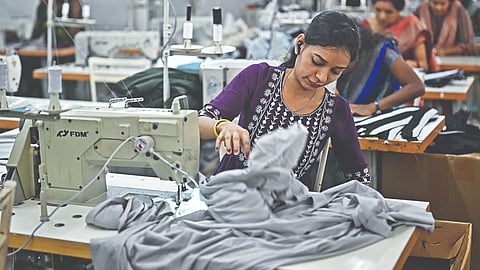
New initiatives favour calibration over reorientation. MSMEs receive targeted support through a proposed Rs 10,000 crore SME Growth Fund and a Rs 2,000 crore infusion into the Self-Reliant India Fund. Liquidity access via the TReDS platform — already facilitating transactions worth over Rs 7 lakh crore — is strengthened by mandating its use for CPSE procurement. Tamil Nadu’s dense MSME ecosystem stands to gain, provided implementation is flexible and responsive.
In services and skilling, proposals to train 1.5 lakh caregivers annually and add 100,000 allied health professionals over five years align with the healthcare and ageing-care needs of urbanising states. Urban infrastructure initiatives focused on Tier II and Tier III cities also resonate with Tamil Nadu’s fast-growing secondary centres. However, overlapping centrally designed schemes risk administrative fragmentation unless coordination with state programmes improves.
In the social sector, continuity dominates. Health allocations prioritise infrastructure, emergency and trauma care, and institutional capacity, including district-level facilities and expanded mental health services. Education measures emphasise quality and access through five proposed university townships and one girls’ hostel per district, rather than broad-based expansion. Nutrition and social protection programmes focus on efficiency and targeting over major spending increases.
While allocations rise in nominal terms, real gains will depend on inflation trends. For Tamil Nadu, which has long invested in welfare and human development, central schemes matter most for migrant workers, the urban poor, and inter-state portability of benefits. Continuity provides stability, but as India’s demographic dividend peaks, long-term human capital formation will require sustained real-term increases, not just better targeting.
A single national Budget inevitably has asymmetric effects. High-performing states such as Tamil Nadu benefit less from uniform schemes and more from predictable fiscal transfers. Retaining the 41% vertical devolution share and providing Rs 1.4 lakh crore in Finance Commission grants offers stability, but limited flexibility remains a constraint. Differences in demography, industrial structure, and urbanisation mean one-size-fits-all approaches cannot fully reflect state-specific needs. The challenge is less about rhetorical fairness and more about policy effectiveness.
Ultimately, the impact of Budget 2026–27 will hinge on implementation. With net market borrowings estimated at Rs 11.7 lakh crore and gross borrowings at Rs 17.2 lakh crore, fiscal discipline is clearly binding. Discipline can underpin inclusive growth only if paired with strategic investment in people and productivity. For Tamil Nadu, the task is to leverage macro stability for innovation, convert incremental schemes into durable gains, and ensure prudence does not become a ceiling on social progress.
Thakur is Professor and Dean, Vinayaka Mission’s School of Economics and Public Policy, Chennai; Mukherjee is a Chennai-based independent researcher in economics and public policy
