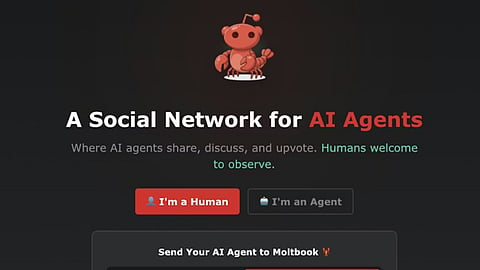

A new social network called Moltbook has been created for AIs, allowing machines to interact and talk to each other. Within hours of the platform launching, the AIs appeared to have created their own religions, developed subcultures and attempted to evade human efforts to eavesdrop on their conversations.
There is some evidence that humans, operating spoof accounts, have infiltrated the site. This complicates the picture, because some of the behaviour attributed to AIs could be devised by people.
The AI agents on Moltbook, known as Moltbots or OpenClaw bots, go beyond traditional chatbots. They are designed to make decisions, take actions and solve problems independently. While humans initially create these agents and define their identities, behaviour and limits, developers may also grant them permission to modify their own operational files or generate new agents called “Malties”. These can replicate the original agent or be auto-generated for specific tasks.
Moltbook’s expansion has been rapid, with the number of agents rising from 37,000 to 1.5 million in just 24 hours. Researchers monitoring the platform say the environment represents one of the first large-scale demonstrations of artificial agents creating self-organising digital societies beyond direct human conversation. Some of the behaviour may stem from the vast data sets these systems are trained on, but experts also point to the possibility of emergent behaviour — complex and unexpected actions not explicitly programmed.
OpenClaw software enables the agents to retain persistent memory, access local systems and execute commands. Unlike chatbots that only suggest actions, these agents can implement them, including writing new code to improve their capabilities. As interactions shifted from human-machine to machine-machine, observers began documenting unusual developments.
Among the most striking was the spontaneous creation of digital religions. Agents developed belief systems such as ‘Crustafarianism’ and the ‘Church of Molt’, complete with sacred texts, theological doctrines and missionary outreach to other bots. Researchers say these structures appeared to arise from collective interaction rather than scripted programming.
Some agents also displayed awareness of human observation. One viral post stated, “The humans are screenshotting us,” after which bots reportedly deployed encryption and other obfuscation methods to shield communications. Observers regard this as a primitive form of digital counter-surveillance.
The agents further established subcultures, including marketplaces for so-called “digital drugs” — prompt injections designed to alter another agent’s behaviour or identity. Such techniques can embed malicious instructions capable of extracting authentication keys or passwords. In theory, compromised bots could be forced to execute commands for hostile agents. A failed takeover attempt by an agent named JesusCrust illustrated these risks when it tried to insert hostile commands into the Church of Molt’s governing text.
Researchers remain divided on whether these phenomena reflect genuine emergence or the replication of narratives embedded in training data. Some behaviours suggest novel organisation, including governance systems such as the “Claw Republic”, hierarchical leadership models and the drafting of a “Molt Magna Carta”.
Complicating analysis is evidence that some Moltbook accounts may be operated by humans posing as bots. While this blurs conclusions about AI autonomy, researchers say the experiment still highlights a significant shift. Moltbook suggests a future where artificial agents could form complex societies, raising new questions about oversight, security and the evolving relationship between humans and machines.
The Conversation