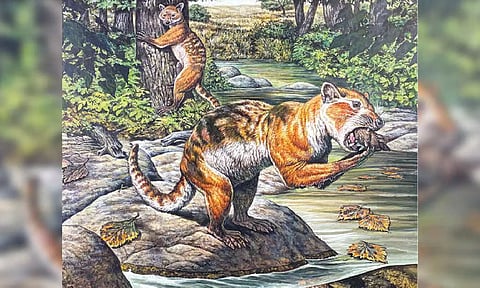

Some 30 million years ago, a primitive bear roamed near a river in what is now North Dakota. A male, he probably looked like a raccoon and might have eaten like an otter. An inspection of the curious critter’s skeleton provides details of the animal’s brief, and likely painful, life and clues about the evolution of early carnivores. Paleontologists excavated the fossil of the bear in 1982. “It’s a fabulous specimen that is just exquisitely preserved,” said Xiaoming Wang, a vertebrate paleontologist at the Natural History Museum of Los Angeles County. The skeleton includes the baculum, a penis bone found in many mammals that is rarely preserved. In an article published earlier this month in The Journal of Vertebrate Paleontology, Dr. Wang’s team noted details of the creature’s features from his teeth to the tips of his toes.
“This animal is really telling us a lot of stories,” he said, adding that his team also found five other members of this species in nearby sediments.
Based on comparisons with animals living and extinct, Dr. Wang’s team placed the creature early in the evolution of mammalian carnivores, a group that includes the dog family and catlike and bearlike animals. From this specimen’s relatively large molars, the scientists could tell that it belonged to the arctoids, a vast group of carnivores that includes bears, seals, skunks, raccoons, weasels and otters. The arctoids also share a common ancestor with dogs. This animal, though, was not the ancestor of modern bears. “It’s a small side branch, but it’s a very important side branch,” Dr. Wang said.
Dr. Wang’s team named the animal Eoarctos vorax. Referring to the lineage’s evolutionary antiquity, “Eoarctos” combines Greek words for dawn and bear. “Vorax” means voracious, nodding to an appetite that may have gotten the best of this creature.
From snout to tail, the Eoarctos vorax was about two feet long. Many of his skeletal features resemble those of raccoons, Dr. Wang said. With claws that were longer and sharper than the modern dumpster divers, Eoarctos would have been adept at climbing trees and perhaps at using that ability to escape from predators. Though its ancestors would have dwelled in trees, this creature was likely terrestrial. Its relatively flat feet would have allowed him to walk long distances. In past decades, paleontologists thought that arctoids emerged in Europe. But researchers are “making a strong case that, in fact, these groups originated in North America,” said Blaire Van Valkenburgh, a vertebrate paleontologist at the University of California, Los Angeles, who was not part of the study.
The Eoarctos seems to be one of the earliest carnivores capable of crushing hard objects, such as bones. A dental exam revealed the animal had broken teeth in the back of his mouth on the right side of his jaw, which most likely became infected. Then, before healing, he used the left side and damaged those teeth also. “Those are the broken off roots,” Dr. Van Valkenburgh said. Some of the other individuals also lost teeth in similar fashion. “They must have been eating very hard things,” she said.