
- Chennai
- Tamil Nadu
- India
- World
- EntertainmentEntertainment
- Business
- Sports
- Lifestyle
- Technology
- Videos
- Explainers
- Editor's Picks
By KATRINA MILLER
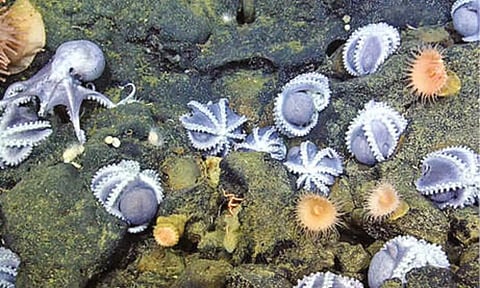
NEW YORK: In 2018, Amanda Kahn, an invertebrate biologist at San Jose State University, joined an ocean expedition to scout the base of Davidson Seamount, an inactive underwater volcano off the coast of central California. She came for the sponges and corals. But she and her colleagues stumbled across something much more astounding. As their remotely operated vehicle, which was probing the seafloor and streaming video back to their ship, rose from behind a rock, the crew gasped. In shimmering waters, they saw scores of upside-down octopuses nestled in rocky crevices with their arms clutched around their frames. A closer look revealed that they were protecting eggs, similar to the way that birds brood in a nest.
“Sometimes you recognise immediately the magnitude of something special that you’ve found,” Dr. Kahn said. “And I think that was one of those special moments.”
When James Barry, a marine ecologist at the Monterey Bay Aquarium Research Institute, got a glimpse on a later expedition, he instantly wondered why so many octopuses were here. “And so we set about to figure out,” he said. Dr. Barry assembled a team of ecologists, biologists, geologists and engineers who, for the next three years, studied what they dubbed the “Octopus Garden” — the world’s largest known aggregation of these eight-legged creatures. It turned out that the sheen of the water was a clue: The nursery sat atop a hydrothermal spring; the shimmering was caused by heat emanating from the seabed. The team’s findings, detailed in a new paper published Wednesday in Science Advances, suggest that this hot spot makes the octopuses’ eggs hatch faster, which improves reproductive success.
The researchers used remote cameras to study the behavior of the grapefruit-size animals, and temperature and oxygen probes to understand the surrounding environment. They witnessed some very intimate moments in the octopuses’ lives: brooding mothers swatting away males seeking to mate, scavengers trying to steal the eggs, and hatchlings “swimming through the gauntlet” of shrimp and anemones waiting to attack, Dr. Kahn said. (The crew cheered whenever a newborn octopus successfully swam off into the dark, she added.)
Using a mosaic of underwater photos spanning a region the size of a few football fields, the team counted 6,000 octopuses in the garden. “And that’s only part of the area,” Dr. Barry said. They estimated that the total population is around 20,000. More than 80 percent of the octopuses at the site were nesting females, identified by their unique, protective postures.
Nudging them aside with probes, the scientists measured how the water around their eggs differed from the ambient environment. They found that temperatures reached up to 52 degrees Fahrenheit at the sites where females chose to brood, compared to only 35 degrees in the surrounding waters. “That’s a big deal for these eggs, because in the deep sea, one of the really big challenges is that it’s cold,” Dr. Barry said. Chilly temperatures slow down the metabolism of cold-blooded animals, including rates of embryonic growth. For this species of octopus, it could have taken anywhere from five to 10 years for the eggs to fully develop in ambient waters — but in this nursery, the scientists found that they were hatching in less than two years on average.
