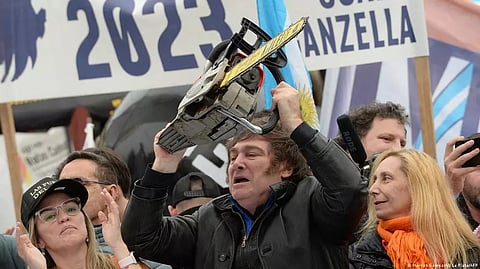

No country owes the International Monetary Fund (IMF) as much as Argentina does — more than $31.1 billion at the present moment. This Friday, IMF representatives were in the Argentinean capital, Buenos Aires, to talk about repayment. The country’s new president, Javier Milei, says he believes the negotiations will be successful.
Milei’s economy drive is “harsher” than demanded by the IMF, writes the Spanish daily El Pais. Since Argentina’s 2001 sovereign debt default, the country has not succeeded in stabilising its state finances. Drawing closer to the IMF, which is extremely unpopular in Argentina, can be seen as a sign of Milei’s desire for rapprochement with Washington.
The president wants to work on relations with the US and the EU, two entities that are ideologically more in step with him, says Detlef Nolte from the German Institute for Global and Area Studies (GIGA) in Hamburg. The fact that Milei’s first official foreign trip, at the end of November 2023, was to the US and not to Brazil, as tradition would have had it, is only one among many signs of this stance, according to Nolte. For him, the basic thrust of Milei’s foreign policy is plain to see.
“I believe we can say that Milei will move Argentina closer to the Western camp,” says Nolte. Milei’s support of Ukraine and Israel fits in with this trajectory. Ukrainian President Volodymyr Zelenskyy attended Milei’s inauguration ceremony on December 10, 2023, at the latter’s invitation. And since the October 7 terror attack by the Islamist militant group Hamas on Israel, Milei has stressed his solidarity with Israel and the Jewish community in Buenos Aires several times.
This self-declared libertarian and “anarcho-capitalist” intends to apply radical measures to end Argentina’s long economic crisis. Workers’ rights are to be curtailed, welfare programs cut and the state’s scope for action reduced to a minimum.
To come to grips with inflation, Milei wants to get rid of the Argentinean peso and make the US dollar the national currency on the premise that this will prevent governments from printing money as needed. The president has often accused his predecessors of “unbridled financial policies” and “clientelistic subsidisation.” He blames what he calls an impenetrable thicket of economic and trade restrictions for weakening the economy even further.
But the shock therapy he plans is controversial. The country’s largest union, which was close to the former Peronist government, has already staged big demonstrations. On Wednesday, an Argentinean court responded to a legal complaint by suspending the president’s decree on a reform of labor laws till further notice. Argentina was once a wealthy country but has been dogged for decades by massive economic problems. Between 1983, the year democracy was reintroduced in the country, and 2021, its gross domestic product has increased by just 29% per capita. To make the comparison: This figure increased in the same period by 48% in the Latin American and Caribbean region as a whole, and by 87% worldwide.
The economic crisis has worsened in the past few years. For example, the official poverty rate grew from 32.2% in 2016 to more than 40% in the first half of 2023. And the annual inflation rate, having remained in the two figures for years, officially hit 161% in 2023 as well.
With regard to international economic policy, Milei is a fan of bilateral rather than multilateral alliances. He has therefore said he wants to leave the South American single market, Mercosur, in which Argentina is partnered by Brazil, Paraguay and Uruguay — unless, he says, a “bigger, better Mercosur” can be created.