
- Chennai
- Tamil Nadu
- India
- World
- EntertainmentEntertainment
- Business
- Sports
- Lifestyle
- Technology
- Videos
- Explainers
- Editor's Picks
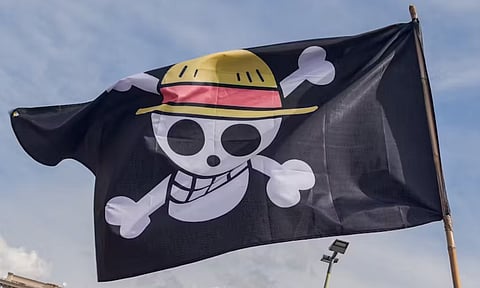
From Paris and Rome to Jakarta, Indonesia, and New York, a curious banner has appeared in protest squares. With hollow cheeks, a broad grin, and a straw hat with a red band, the figure is instantly recognisable and has been hoisted by young demonstrators calling for change. In Kathmandu, where anger at the government boiled over in September 2025, the flag became the defining image as flames spread through the gates of Singha Durbar, Nepal’s ornate palace complex and seat of power.
The image, usually adorning a flag with a black background, comes from ‘One Piece’, a much-beloved Japanese manga.
And what began as a fictional pirate crew’s emblem almost three decades ago has become a powerful symbol of youth-led resistance, appearing in demonstrations from Indonesia and Nepal to the Philippines and France. The spread of the Jolly Roger of the Straw Hats Pirates – which has gone from manga pages to protest squares – is an example of how Gen Z is reshaping the cultural vocabulary of dissent.
“One Piece” arrived at the birth of Gen-Z, created in 1997 by Japanese manga artist Eiichiro Oda. Since then, it has sold more than 500 million copies and has a Guinness World Record for its publishing success.
It has spawned a long-running TV series, live-action films, and a more-than-$20 billion industry, with merchandise licensing alone generating about $720 million each year from Bandai Namco, the company best known for creating Pac-Man and Tekken.
At its core, “One Piece” follows Monkey D. Luffy and his crew, the Straw Hat Pirates, as they challenge a corrupt world government while seeking freedom and adventure.
For fans, the ‘One Piece’ flag is not a casual decoration but an emblem of defiance and perseverance. Luffy’s ability to stretch beyond physical limits after consuming a magical fruit has become a powerful metaphor for resilience, while his unwavering quest for freedom against impossible odds resonates with youth navigating political environments marked by corruption, inequality, and authoritarian excess.
When protesters adopt this flag, they are not simply importing an aesthetic from popular culture, but are drawing on a narrative already legible to millions.
The flag began cropping up in protests over the past few years. It was being waved at a “Free Palestine” protest in 2023 in Indonesia and in New York during a pro-Palestinian demonstration.
But it was in Indonesia in August 2025 that the flag’s political life truly took hold. There, protesters embraced it to voice frustration with government policies and mounting discontent over corruption and inequality. The timing coincided with government calls for patriotic displays during independence celebrations, sharpening the contrast between official nationalism and grassroots dissent.
The movement gained momentum when authorities responded with strong criticism of the flag’s use, inadvertently drawing more attention to the symbol. Government officials characterised the displays as threats to national unity, while protesters viewed them as legitimate expressions of political frustration.
The speed with which the “One Piece” Jolly Roger flag spread across borders reflects the digital upbringing of Gen Z. Solidarity in this setting does not require party membership or ideology. Instead, it depends on shared cultural references. A meme, gesture, or flag can instantly carry meaning across divides of language, religion or geography. This form of connection is built on recognisable cultural codes that allow youth to identify with each other.
Social media gives this solidarity reach and speed. When protesters in Jakarta, Kathmandu or Manila wave the “One Piece” Jolly Roger flag, they are not indulging in play-acting but transforming a cultural icon into a living emblem of defiance.
The Conversation
