
- Chennai
- Election-2026Election-2026
- Tamil Nadu
- National
- World
- Cinema
- Business
- Sports
- Lifestyle
- Technology
- Videos
- Explainers
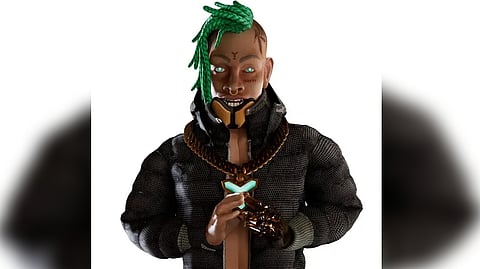
The story of FN Meka — a fictitious character billed as the first musical artist partly powered by artificial intelligence to be signed by a major record label — might seem like a bizarre one-off. In August, Capitol Records dropped FN Meka, whose look, outlaw persona and suggestive lyrics were inspired by real-life music stars like Travis Scott, 6ix9ine and Lil Pump, amid criticism that the project trafficked in stereotypes.
But to seasoned observers of technology in pop music and the debate over cultural appropriation, the rise and fall of this so-called robot rapper, whose songs were actually written and voiced by humans, has raised important questions that are not going away anytime soon.
Last month alone, an A.I. artwork won a prize in Colorado and a computer program improvised a classical music solo in real time in New York City. From DALL-E 2, the technology that creates visual art on command, to Hatsune Miku, a Japanese software that does something similar for music, the arts world may be on the precipice of a sea change in how its products are created. And young people feel increasingly at ease consuming culture via digital avatars like FN Meka. It has already been happening in hip-hop: A hologram of the rapper Tupac Shakur, who died in 1996, performed at a music festival in 2012; Travis Scott gave a concert through his avatar in the video game Fortnite in 2020; and Snoop Dogg and Eminem rapped as their digital selves and their Bored Ape avatars in a metaverse performance at the MTV Video Music Awards last month.
In this brave new world, do fake characters based on real people amount to unseemly borrowing, even theft, or just the kind of homage that has always defined pop music? Even when artificial intelligence does help write music, should the humans behind it be accountable for the machine-created lyrics? And as far as race is concerned, how do the rules of cultural appropriation work when the person doing the appropriating is not a human being with a unique cultural background but a fictitious identity backed by an anonymous, multiracial collective?
“A lot of our moral intuitions and codes as humans may have evolved for a context where we have discrete human actors,” said Ziv Epstein, a Ph.D. student at the M.I.T. Media Lab who studies the intersection of humans and technology. “These emerging technologies require new legal frameworks and research to understand how we reason about them.”
For FN Meka’s critics, the presence of more Black people or people of color in the rooms where the character was conceived, designed and promoted may have helped prevent the negative stereotypes that they say it furthered. Industry Blackout, a nonprofit advocacy group, said FN Meka “insulted” Black culture and leeched off the sounds, looks and life experiences of real Black artists. Capitol seemed to agree when it apologized for its “insensitivity” in a statement.
To the critics, FN Meka’s (exaggerated) debt to A.I. and its exclusively digital existence had the effect of absolving the people who were really calling the shots. “There are humans behind technology,” said Sinead Bovell, a futurist and the founder of WAYE, an organization that educates young people about technology. “When we disconnect the two, that’s where we could potentially risk harm for different marginalised groups.
Visit news.dtnext.in to explore our interactive epaper!
Download the DT Next app for more exciting features!
Click here for iOS
Click here for Android