CHENNAI: A growing number of people in Western nations have lost faith in democratic governance and a free press, and who have turned to conspiracy theories to fill the void. Rejecting what they hear from scientists, journalists or public officials, these people instead embrace tales of dark plots and secret explanations. And their beliefs, say experts who study misinformation and extremism, reflect a widespread loss of faith in institutions like government and media.
A poll conducted last year by AP-NORC Center for Public Affairs Research found that just 16% of Americans say democracy is working well or extremely well. Another 38% said it’s working only somewhat well. Other surveys reveal how many people in the United States now doubt the media, politicians, science and even each other. The distrust has gone so deep that even groups that seem ideologically aligned are questioning each others’ motives and intentions.
When an extremist website that sells unregulated ghost guns — firearms without serial numbers — asked its followers about their July 4th plans, several people responded by accusing the group of working for the FBI. When someone claiming to be Q, the figure behind QAnon, reappeared online recently, many conservatives who support the movement speculated that the new Q was actually a government plant. The global public relations firm Edelman has conducted surveys about public trust for more than two decades, beginning after the 1999 World Trade Organization’s meeting in Seattle was marred by anti-globalisation riots. Tonia Reis, director of Edelman’s Trust Barometer surveys, said trust is a precious commodity that’s vital for the economy and government to function.
“Trust is absolutely essential to everything in society working well,” Reis said. “It’s one of those things that, like air, people don’t think about it until they realise they don’t have it, or they’ve lost it or damaged it. And then it can be too late.”
For experts who study misinformation and human cognition, the fraying of trust is tied to the rise of the internet and the way it can be exploited on contentious issues of social and economic change.
Distrust and suspicion offered obvious advantages to small bands of early humans trying to survive in a dangerous world, and those emotions continue to help people gauge personal risk today. But distrust is not always well suited to the modern world, which requires people to trust the strangers who inspect their food, police their streets and write their news. Democratic institutions, with their regulations and checks and balances, are one way of adding accountability to that trust.
When that trust breaks down, polarisation and anxiety increases, creating opportunities for people pushing their own “ alternative facts.” “People can’t fact check the world,” said Dr. Richard Friedman, a New York City psychiatrist and professor at Weill Cornell Medical College who has written about the psychology of trust and belief. “They’re awash in competing streams of information, both good and bad. They’re anxious about the future, and there are a lot of bad actors with the ability to weaponise that fear and anxiety.”
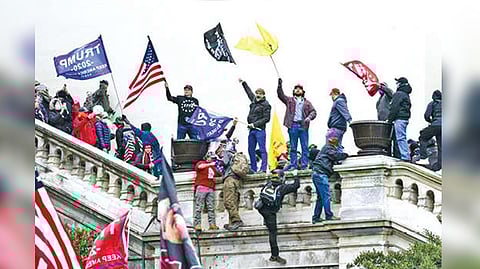
Those bad actors include grifters selling bad investments or sham remedies for COVID-19, Russian disinformation operatives trying to undermine Western democracies, or even homegrown politicians like Trump, whose lies about the 2020 election spurred the Jan. 6 attack.
Research and surveys show belief in conspiracy theories is common and widespread. Believers are more likely to to get their information from social media than professional news organisations. The rise and fall of particular conspiracy theories are often linked to real-world events and social, economic or technological change.
Associated Press
Visit news.dtnext.in to explore our interactive epaper!
Download the DT Next app for more exciting features!
Click here for iOS
Click here for Android