
Chennai
After concerns were raised about the impact of making children, including those in primary classes, carry heavy schoolbags, the Union Ministry of Human Resources Development (MHRD) issued a circular that specified the maximum weight of the bags that the students of different classes should be made to carry. But, despite widely known effect such heavy weight has on the spine and nervous system, the situation has not changed on the ground even after the circular was issued to states and union territories.
VS Ashokan, the father of a Class 3 student of a private school in Alwarpet, was relieved when he learnt about the circular. The 35-year-old was worried about the heavy bag that his daughter was forced to carry to school every day.
The feeling, however, was short-lived, as there was little change in reality; his daughter continued to bear the same weight. “The move was good, but the rule has not been imposed strictly. My daughter continues to carry a schoolbag that weighs more than five kg. In addition to that, she also has to carry lunch box and water bottle,” Ashokan said.
Many parents like him are demanding that the schools follow the rules and guidelines, which remain only on papers.
What MHRD guideline says
In its circular, the MHRD has instructed all states and union territories to draw guidelines and regulate the teaching system and the weight of school bags with immediate effect. The circular laid out specific instructions which should be implemented with immediate effect by all schools under the Department of Education.
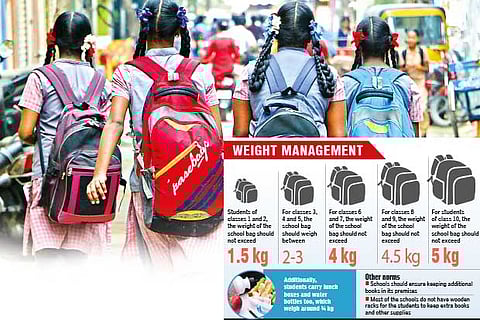
As per the Union Ministry circular, the weight of schoolbags for students of Classes 1 and 2 should not exceed 1.5 kg. Similarly, the maximum weight of the bags for Classes 3 to 5 students is 2-3 kg, it is 4 kg for Classes 6 and 7, 4.5 kg for Classes 8 and 9, and 5 kg for Class 10 students.
The circular added that the students should not be asked to bring additional books and other materials apart from the prescribed textbooks. Schools should make sure that students carry only the textbooks that are necessary as per the time-table, it added.
MHRD norms flouted
Despite such specific guideline, most schools in Chennai, especially at the primary level, do not follow this, forcing their students to continue carrying heavy bags.
S Shalini, a Class 4 student of a private school at Pammal, walks for about 10 minutes to reach the school from her home while carrying a bag which weighs more than five kg. “We have to carry seven text books and notebooks to school every day. Sometimes, it is difficult for us to even lift it,” she said.
Another student, R Kiran Kumar of Class 7, carries a schoolbag that weighs 6.5 kg – more than half in excess of the MHRD’s guideline under which it should be only 4 kg. “My shoulder pains by the time I return from school and climb the stairs to my house on the second floor,” he said. For him, there are five subjects, which together have seven textbooks each with a separate notebook.
The situation is similar for J Hasini, a Class 2 student who is carrying a bag that weighs around 3 kg – double of the 1.5 kg prescribed by the Ministry. Hasini’s mother J Gayathiri said she had requested the school management to reduce the weight of the bag but in vain.
Health implications of carrying heavy bags
According to doctors, heavy bags can cause various spine deformities in the long run and can also affect the nervous system of the child.
“Some of the common problems seen in younger children are back pain, abrasions in body and pain in hands because of carrying heavy school bags every day. The alignment of the posture of the child gets affected, which impacts the nervous system. It can cause imbalances in the body,” said Dr Mohan Kumar, a senior consultant paediatrician at Institute of Child Health.
Noting that parents often ignore everyday complaints like lower back pain, he said the constant pain could lead to depression in children, which may make them averse to studies in some cases.
Parents do not take every day symptoms such as lower back pain or injuries into account and ignore them. The constant pain leads may depress the children and they develop an aversion towards studies in some cases, added Dr Mohan.
Doctors said the prevalence of spinal deformities and posture issues are increasing among children. “Spinal deformities are likely to occur in the long run, as heavy bags strain the muscles and forces the body into an unnatural posture.
Heavy loads can put pressure on the back and musculoskeletal pain in the shoulders, spine and pelvic region in children,” said Dr Nalli Uvaraj, the chief spine specialist at Rajiv Gandhi Government General Hospital, pointing out that many parents overlook the side-effects.
Schools and government stance
“Children, especially at the elementary level, are usually extremely possessive about their books. Whether the book is needed or not, they would carry it despite us asking them to carry limited study materials,” claimed K Savithiri, the principal of a private school in Pallavaram. It is the parents who should ensure that the children carried only the books that are necessary, she added.
A school education officer from the Directorate of Public Instruction (DPI) said the Directorate of School Education has prescribed only limited number of text and notebooks, adding that it would not increase the weight of the bag. “As per the rules, if the students face any difficulty in carry many books, they can keep the additional workbooks at the school itself,” he added.
But, P Rajalakshmi, assistant principal of a government school in Anakaputhur, admitted that as per the norms every school should ensure proper facilities for students to keep their books so that they don’t have to carry them every day. “Most schools, however, do not have racks to keep them, which forces them to carry all books every day,” she said.
Visit news.dtnext.in to explore our interactive epaper!
Download the DT Next app for more exciting features!
Click here for iOS
Click here for Android