
Chennai
Recounting my stay in the Garden City, as I entered Asha Dey’s house there, I was looking forward to further strengthening my 35-year-old friendship with her. The first person I met at her home was Lakshmi, her full-time house help. She asked me in fluent English, whether I would like a cup of tea and I sat there, admiring her diction and hospitality. Lakshmi is an integral part of the household and me being a guest, I felt she looked after me very well. Her happiness and love showed in the food she served us and her terrific cook made even mundane, everyday food taste different and tasty.
When she and I got talking about food, she expressed interest in wanting to know the origin and history of some dishes I mentioned, and requested me to demonstrate the preparation to her. Her infectious enthusiasm made both of us decide to cook a nice meal consisting unusual south Indian dishes, which were not available in restaurants.
She wanted a vegetarian dish which tasted like non-vegetarian and the perfect answer was mushroom. Though it is a fungus, the taste and texture is almost like meat and hence is popular with most non-vegetarians.
Mushrooms were believed to the ‘plant of immortality’ by the ancient Egyptians, 4,600 years ago. It was the food of royal family and commoners were denied of it. Even in the civilizations of Russia, China, Greece, Mexico and Latin America, the same ritual was practiced. Many assumed that the consumption of mushrooms could produce super-human strength, help in locating lost objects and make one reach the Gods.
Initially, edible mushrooms were used mainly in Chinese and European food, but now have become global. In Indian cooking, it made a rather late entry but has become a popular across the country today.
Paddy straw mushroom (Volvariella Volvacea), also known as Chinese mushroom, ranks sixth among the cultivated kinds of the world. It began being grown in India in 1940 – first at Coimbatore – and then found its way into some coastal states like Orissa, Andhra Pradesh, West Bengal, other parts of Tamil Nadu and Kerala. These fungi are a rich source of fibre, thiamine, riboflavin, niacin, biotin, ascorbic acid, selenium, potassium and phosphorous.
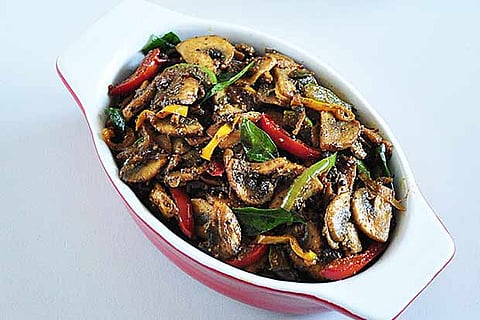
Since mushrooms are versatile and easy to cook, the addition of Indian spices makes them even more delicious. Kalan milagu is a classic mushroom dish with peppercorns. I add a zing of garlic and onions to make it an excellent side dish that can be served with rice.
Kalan Milagu Varuthathu
Prep time: 10 mins
Cook time: 30 mins
Serves: 4
Calories per serve: 310 cal in a small cupful
Ingredients
Button mushrooms: 400 gm
Coconut oil: 1 tbsp
Shallots: 1/2 cup, chopped
Ginger paste: 1 tsp
Garlic paste: 1 tsp
Tomatoes: 2, chopped finely
Red chilli powder: 1/2 tsp
Coriander powder: 2 tsp
Black peppercorns: 2 tsp, crushed
Salt: To taste
Green chillies: 1, slit
Garam masala: 1 tsp (optional)
Turmeric powder: 1 tsp
Coriander: 1/4 cup, chopped
Curry leaves: A few
Coconut milk: 3/4 cup
Method
Kitchen Tip
— Chef Ramaa Shanker is the author of Festive Offerings to the Gods: Divine Soul Recipes
Visit news.dtnext.in to explore our interactive epaper!
Download the DT Next app for more exciting features!
Click here for iOS
Click here for Android