
Chennai
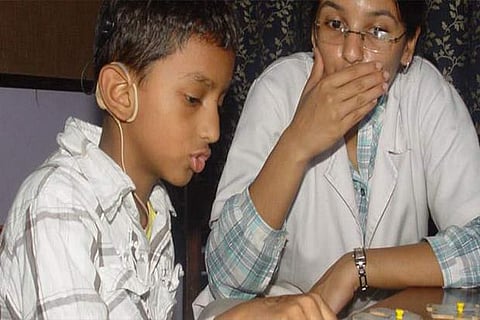
A cochlear implant is an electronic medical device that substitutes the function of the damaged inner ear. However, unlike a hearing aid, cochlear implants bypass the damaged hair cells of the inner ear (cochlea) to provide sound signals to the brain.
One to three children in every 1,000 kids is/ are believed to suffer from hearing loss that doesn’t get noticed in time, thereby denying chance for early intervention. What makes it more frustrating for experts is the fact that the issue can be identified even a day after a child’s birth.
Professor Dr JM Hans, a Padmashri Awardee and the ENT surgeon and Cochlear Implant Surgeon, Rainbow Children’s Hospital, said that the good news was that hearing loss was a disability that can be treated successfully. “While there are different categories of hearing loss- mild, moderate and severe, each of it can be attended to by various kinds of treatment, it could even be by just cleaning the wax, or on the other hand by brainstem implant.”
He said that given the effective ways to diagnose it at the earliest through a test like the otoacoustic emission (OAE) that can find out if there is a problem either before the first vaccination or discharge from the hospital, cochlear implant can make lives normal. Added Dr Hans, “When the implants are done at the age of eight months, the child can lead a completely normal life – talking, hearing and understanding without any issue.”
He added that awareness was the key and that given that now experts knew for sure stem cells were not going to offer the solution; it was time to embrace the implants completely. “That is why companies are working on improving the implants. Earlier, we thought stem cells could be a solution, but we have realised now it can’t be as the damaged hair cells cannot be regenerated irrespective of the cause for the damage.”
Prakash Boominathan from the Department of Speech, Language and Hearing Sciences, Sri Ramachandra University. Pointed out that bigger hospitals were carrying out the test “Most multispecialty hospitals perform the test and some also do a follow up for three months and the rehabilitation can begin early.” he added, echoing Dr Hans’ words.
Some of the most common reasons for hearing problems at birth is neonatal jaundice, mother suffering from TORCHS (Toxoplasma, others, rubella, cytomegalovirus - CMV, herpes) Infection in the first trimester, consanguinity and family history of the problem, says Dr Ravi Ramalingam, Senior ENT Consultant, KKR ENT Hospital & Research Institute, whose study of 5,000 new-borns found that 2 per 1,000 had hearing problems.
Reasons and response
Visit news.dtnext.in to explore our interactive epaper!
Download the DT Next app for more exciting features!
Click here for iOS
Click here for Android