
- Chennai
- Election-2026Election-2026
- Tamil Nadu
- National
- World
- Cinema
- Business
- Sports
- Lifestyle
- Technology
- Videos
- Explainers
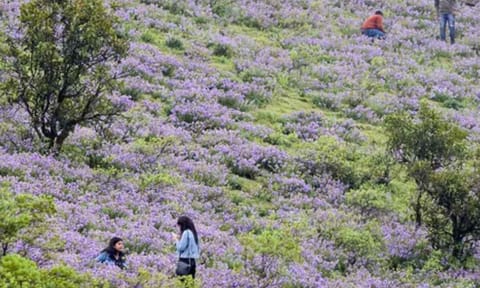
CHENNAI: The unpredictable climate change in Western Ghats is affecting Neelakurinji, which flowers once in 12 years, the Botanical Survey of India (BSI) informed the National Green Tribunal (NGT).
Except some populations in the protected areas, the main areas that once had Neelakurinji shurb, which is endemic to the southern parts of the Western Ghats, are severely fragmented, with the numbers falling to less than 500 plants, it said in a report to the tribunal, adding that the major reason for the population reduction is the loss of habitat.
"It is also pertinent to mention herein that besides the unpredictable climate change of this area (Western Ghats), the long 12 years of flowering cycle duration of Neelakurinji and the change of pollinators are the potential threats for change in the reproductive potential of the species," the report added.
Pointing out that the Neelakurinji are found in revenue lands, the BSI pointed out that the plants were recently found at lower altitudes of 1,100 metres, in contrast to the general belief that it grows only in altitudes of 1,340 to 2,600 metres.
The NGT is hearing a suo motu case based on inclusion of Neelakurinji on the International Union for Conservation of Nature (IUCN) official Red List of threatened species in August 2024.
The BSI clarified that the concerned State government should send a proposal to the Ministry of Environment, Forest, and Climate Change for including any species under the threatened species under the Biological Diversity Act, 2002. However, no proposal for Neelakurinji’s inclusion has been received so far from any government to declare it as threatened, it said.
It added that undertaking a revisit and reassessment in the affected area by the BSI was required to submit accurate scientific data on the reduction of Neelakurinji.