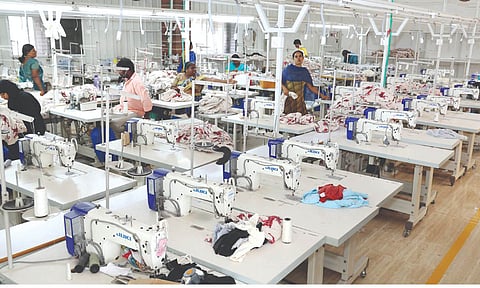

COIMBATORE: Thirty-seven-year-old Pradhan Kumar from Bihar, who is settled down in Tirupur, has been gripped in fear over the looming threat of financial downturn due to the US tariff impact.
His workplace, which used to buzz with activity, has now fallen silent. “I had over 100 migrant workers employed. Since work orders dropped drastically over the last three weeks, I have retained just ten people and laid off others. Even these few work only till the afternoon. It’s a crisis I have never seen before,” says Pradhan Kumar.
He came to the ‘dollar city’, some 20 years ago, did odd jobs, and gradually picked up the nuances in garment manufacturing to gain the confidence of larger firms, which now outsource their entire range of work from sourcing fabric, cutting, and knitting to deliver back as a made-out garment.
After all these years of progress in the textile hub, Pradhan Kumar seems to be now left in a piquant situation. “I managed to pay fees for my three children, studying in Classes 8, 5, and 4 in a private school here, but I am worried about arranging money to pay EMI for my house built near the GN Garden area,” he said.
Like him, many others who came down to Tirupur from north Indian states to realise their dreams of better fortunes, are staring at a bleak future due to the US tariff on Indian goods.
Having come to Tirupur from Bihar as a teen, around 15 years ago, Sanoj Kumar, who is better known among the local people as Santhosh Kumar, says that a large number of migrant workers have already left Tirupur, and those staying back get to work only for a few days a week. He is now 32 years old.
A similar crisis arose during the COVID-19 pandemic, when migrant workers left Tirupur in droves due to a lack of work. “Currently, we get to do only 40 per cent of the actual work. I have asked those in my hometown not to come to Tirupur as there is no work even for the existing workers. A worker gets Rs 500 to Rs 700 as daily wages in a textile unit,” said Sanoj Kumar, who works as a supervisor in a textile firm in Pooluvapatti.
However, he claims to have been jobless for the last few weeks. “In our firm, 15 people have gone back to their hometowns; some have switched over to construction work, with many others whiling away time in their rooms, hoping for the situation to return to normalcy. I myself had brought up to 500 people from Bihar in all these years to work in garment units in Tirupur,” he said.
His wife and three children – twin boys and a daughter are staying in their hometown in Bihar at his paternal home. “When I came to Tirupur, I was empty-handed and had just the clothes that I wore. I started as a helper, did odd jobs like buying tea, cleaning cars, and other errands in companies. Over the years, I learnt the nuances of work, and now I own a house and run three mobile accessories shops. But things may not remain the same anymore if the current situation prevails. I am now unable to pay monthly school fees for my children,” he said.
Of the over five lakh workforce, migrants from Bihar, Jharkhand, Odisha, West Bengal, and Uttar Pradesh constitute a major share. Besides the textile sector, the US tariff impact has also taken a drastic hit on the local businesses.
“Migrant workers used to send money to family members in their hometown, which comes around a few lakhs every week. But, over the last month, the money sent by our regular customers has reduced one fourth due to joblessness. Our total volume of business has come down drastically,” said a staff of SK Mobiles at Indira Nagar.
Centre of Indian Trade Unions (CITU) general secretary G Sampath said Tirupur may face a job loss of up to 20 per cent due to the impact of a 50 per cent tariff by the US.
“Yet, such job loss may not be known visibly, as up to 60 per cent of workers do not come under the organised sector. Others are facing the grim reality of a reduction in wages, no overtime, and a drop in the number of working days. As the government does not have proper data on the migrant workforce in Tirupur, it will be difficult to ascertain the exact impact of the issue,” he said.