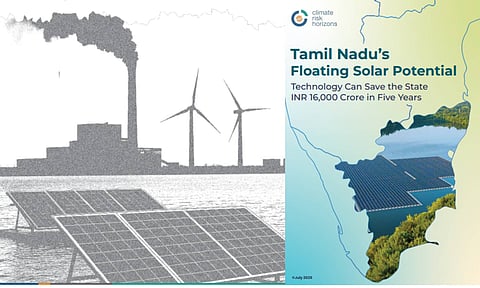

CHENNAI: Tamil Nadu can generate 3.5 GW of electricity from floating solar photovoltaic (FPV) systems on 57 of its reservoirs, saving over ₹16,000 crore in five years, according to a report by think tank Climate Risk Horizons (CRH). The study highlights the state’s opportunity to reduce reliance on expensive coal power while moving closer to its climate and energy targets.
The report estimates that this FPV capacity can produce 7,777 million units (MU) of electricity annually at an average tariff of ₹3.16/kWh, less than half the cost of electricity from state-run thermal power plants, which averages ₹7.12/kWh. By phasing out 1.68 GW of high-cost coal power from plants like North Chennai and Tuticorin, Tamil Nadu Generation and Distribution Corporation (TANGEDCO) could save ₹3,211 crore annually.
The initiative aligns with Tamil Nadu’s goal of becoming carbon-neutral ahead of the national 2070 target and increasing renewable energy’s share to 50% by 2030. The Tamil Nadu Green Energy Corporation Limited (TNGECL) is expected to drive this transition.
“These savings are equivalent to nearly half of TANGEDCO’s 2023-24 losses, which stood at ₹6,920 crore,” said Ashish Fernandes, CEO of Climate Risk Horizons and co-author of the report. He added that the shift to FPV offers a financially sound pathway for the state’s transition to cleaner energy.
TANGEDCO carried a total debt of ₹1.8 lakh crore before its restructuring. The newly created distribution company, Tamil Nadu Power Distribution Corporation Limited (TNPDCL), is now responsible for ₹90,000 crore of that debt. The TNERC has increased tariffs four times since 2022 in a bid to manage losses, with the burden falling on end users.
Tamil Nadu has announced plans to add 20 GW of solar power and 10 GW of battery storage by 2030. Floating solar is expected to play a key role in achieving these targets. FPV systems do not require land acquisition and also help reduce evaporation in reservoirs – in 2018, evaporation from major reservoirs was nearly 374 billion litres, which is about 45% of Chennai’s projected annual water demand for 2025.
The report notes that FPV installation should avoid ecologically sensitive areas such as national parks and tiger reserves. Around 750 MW of potential capacity lies within such zones. It also stresses the importance of protecting community rights, particularly in areas where fishing or local water use could be impacted.
Prabhakaran Veerarasu of Poovulagin Nanbargal said floating solar offers a rare opportunity to cut costs while reducing emissions. Hari Subbish Kumar of Asar Social Impact Advisors added that FPV development would also attract investment and jobs, helping the state meet its renewable energy and economic goals.