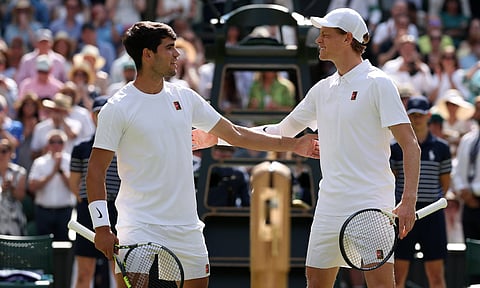

CHENNAI: On Sunday, Jannik Sinner and Carlos Alcaraz met in the final of the US Open, as they did a few months ago at Wimbledon and the French Open. They have one of the most electrifying rivalries in sports, and their duels — fast, fierce and breathtaking — seem to push each other to new heights as the two swap world No 1 rankings.
“Alcaraz is prone to sometimes playing distracted matches, but every time he steps up to play Sinner, it’s the best tennis he’s ever played,” said Giri Nathan, author of ‘Changeover: A Young Rivalry and a New Era of Men’s Tennis’. “They see it as a privilege that they get to play each other — rather than an obstacle.”
Rivalries can get a bad reputation, and some research has even linked them to more cut-throat and unethical behaviour. But healthy rivalries can sharpen focus, boost motivation and improve your performance, even if you’re not competing on the world’s biggest stages.
“Rivalries encourage us to think outside of the box and to push our boundaries above and beyond what we know is possible,” said Matt Moore, a tennis coach and an associate professor of social work at University of Kentucky.
Sinner and Alcaraz offer three key lessons about how to harness rivalry in your own life — whether you’re angling for a promotion, trying to beat your friend at pickle-ball or setting out to prove you’re the favourite child.
Lean into curiosity
“The on-court rivals have different tennis DNA, with Sinner being calm and methodical, like permafrost, and Alcaraz running hot and unpredictable,” Nathan added.
Experts say they draw inspiration from each other, refining the weaker parts of their game. “He’s a player who makes me a better player,” Sinner said about Alcaraz after the two faced off at Wimbledon. “Every one of us needs someone who pushes ourselves to the limits.”
In your own life, instead of viewing a rival as someone to defeat, try to see that person as someone you can respect and learn from. “The person you hate at work — your work enemy — isn’t necessarily a good rival,” said Benjamin Converse, a professor of public policy and psychology at University of Virginia, because a healthy rivalry should cultivate curiosity and mutual growth — not resentment.
“Focusing on mastery instead of the outcome has even been linked to less anxiety and depression, more confidence and, perhaps paradoxically, better performance,” said Stephen Garcia, who studies the psychology of competition at the University of California, Davis, Graduate School of Management.
In practice, you might ask yourself, ‘What do I respect about this person’s approach, and how can I adapt that to my own work?’ “If you find yourself spiralling into jealousy and resentment, take a moment to reflect on how your rival might be motivating and pushing you to greater heights,” said Gavin Kilduff, a professor of management and organizations at NYU Stern School of Business. “There is a basis for cooperation in rivalries. You inspire each other, you learn from each other, and then you both succeed together.”
Don’t dwell on the outcome
“What distinguishes a rivalry from a standard matchup is that you and your rival have a shared story around competition,” Converse added. “But when you’re competing, it’s best to meet each moment on its own terms, instead of feeling burdened by previous losses or the larger stakes.”
At the French Open in June, Sinner suffered a heart-breaking loss to Alcaraz, but a month later defeated him at Wimbledon, as if Paris never happened.
So compete fiercely at work, in the classroom or on a tennis court, but then leave the competition at the door. “We have a good friendship,” Sinner said about Alcaraz during a post-match news conference Monday. “We’re enemies when we step on the court, and we push the other to the limit. But it ends there after the handshake.”
Every tennis match or job promotion might feel zero-sum in the moment. But remember that your journey — whether athletic or professional — is larger than any single contest. “So while you don’t have to take every loss with a smile, adopting that longer-term perspective is key to keeping a rivalry healthy,” Kilduff said.
Turn your nerves into fuel
Still, Alcaraz is often smiling and laughing on the tennis court, while Sinner has said he feels a childlike wonder while playing. While rivalries tend to be linked to more stress, in moderation that stress can contribute to a positive mood, increased productivity and better decision-making.
“Beyond intensity, part of what distinguishes ‘good’ and ‘bad’ stress is whether you see the rivalry as a challenge that energises you or a threat that exhausts you,” Kilduff pointed out. In your life, it might be the difference between working late on a passion project versus burning out on tasks you resent — just to keep up with your rival.
“Those with less experience are more likely to slip into a threat mind-set and be harmed by a rivalry, since they might find the extra pressure overwhelming,” he added. “So if you’re just picking up pickle-ball, for example, it might be good to avoid playing your rival until you’ve built up your confidence and skill level.”
Regardless of your experience, the key is to use your competition as fuel. “A rivalry that is healthy for you is one that generates excitement,” Moore said. “The best rivalries don’t just test you. They remind you why you love what you’re doing in the first place.”
@The New York Times