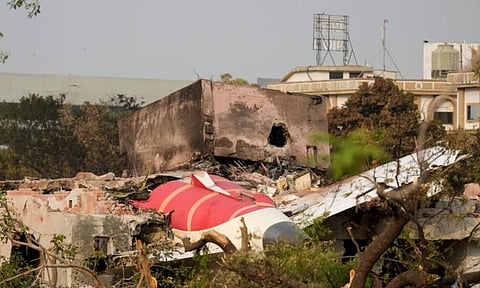

CHENNAI: The preliminary report by the Aircraft Accident Investigation Bureau (AAIB) into the crash of Air India flight AI 171 offers some answers but leaves key questions about the crash sequence unanswered. The 15-page report released on Saturday says the engine fuel switches moved to CUTOFF position mid-air, causing cockpit confusion, cutting fuel supply and causing power loss, now a key focus of the probe.
On June 12, Air India flight AI 171, a Boeing 787-8 Dreamliner with registration VT-ANB, bound for London Gatwick, crashed almost immediately after take-off from Ahmedabad on June 12. The aircraft rammed into the BJ Medical College hostel and adjoining structures before exploding in flames.

There were 242 people on board, including 10 cabin crew and two pilots. Only one, a passenger, survived. Several people on the ground were also killed, bringing the total death toll to 260 in the deadliest aviation accident in a decade.
Usually, it takes investigators several months to complete a full and final report on the exact cause of the incident. But according to Indian aviation regulations, the AAIB must submit a preliminary investigation report within 30 days of any aircraft accident. As per this, the report submitted to the Government of India’s Ministry of Aviation presents initial findings but does not draw conclusions.
Ram Air Turbine (RAT) deployment confirmed
The Ram Air Turbine, or RAT, is a small emergency turbine that automatically comes out during major technical failures such as a loss of hydraulics, loss of power, or failure of both engines. The AAIB report confirms with both video and flight data that the RAT was deployed soon after takeoff. The aircraft became airborne at 08:08:39 UTC, and the RAT started producing power just eight seconds later, at 08:08:47 UTC.
This is an important finding because early crash videos were not clear, and there was a lot of debate about whether the RAT had deployed at all. The report settles that question with solid proof.
Unexplained fuel cut-off
What stands out is what happened just before the RAT started working. At 08:08:42 UTC, only three seconds after the aircraft lifted off the ground, the fuel cut-off switches for both engines moved from RUN to CUTOFF position. The switches moved within a second of each other, causing both engines to begin losing power.
The report does not yet include the full voice recordings from the cockpit, but it does mention that one pilot is heard asking the other why the fuel was cut off, while the other pilot denies.
The switches were moved back to the RUN position a few seconds later. Engine 1 was switched back at 08:08:52 UTC and Engine 2 at 08:08:56 UTC. When the switches are moved back to RUN while in flight, the aircraft’s computers restart the engines.
According to the report, Engine 1 began to recover, but Engine 2 struggled all the way to the crash. Investigators found thermally damaged remains of the thrust levers and the fuel control switches. Both switches were found in the RUN position, which supports the data.
The report does not directly link RAT deployment to engine fuel cut-off, but aviation experts say it is a likely possibility.
READ HERE: What are fuel switches?
Thrust Lever confusion
The report also points to a contradiction. While the flight recorder shows that the thrust levers (the primary controls pilots use to manage engine thrust by regulating fuel supply) were in the forward take-off position (take-off thrust) until the crash, they were found near the rear idle position in the wreckage. This is still unexplained.
Although videos show the aircraft descending, the report does not provide complete details about the aircraft’s altitude.
MAYDAY Call, then silence
At 08:09:05 UTC (which is 13:39:05 IST), eighteen seconds after the RAT began working, a pilot made a MAYDAY call on the radio. The call did not include the flight number. The air traffic control tower asked for the call sign, but there was no response. Just six seconds later, at 08:09:11 UTC (13:39:11 IST), the flight data recorder stopped recording, indicating the crash had happened.
The report also explains how the crash happened. The aircraft first struck a series of trees and an incinerator chimney within the Army Medical Corps compound before crashing into the northeast wall of the hostel mess building—just 0.9 nautical miles (1.667 km) from the end of the airport runway. As it moved forward, the aircraft continued to break apart, hitting multiple structures and vegetation, with wreckage spread across an area of approximately 1,000 by 400 feet.
Flaps and Landing Gears
There were earlier doubts about the flap setting, which is the degree to which an aircraft's flaps are extended during take-off, landing, or other flight phases. The report confirms that the flap handle was correctly set at five degrees, which is normal for take-off. However, the landing gear lever was found in the DOWN position, though the report does not explain why.
The report does not recommend any safety changes for the Boeing 787-8 aircraft or its GE GEnx-1B engines, which indicates that, so far, no faults have been attributed to either.
Since this is only a preliminary report, some details remain unclear, and it is too early to determine whether the crash resulted from a technical fault or human error. The final report, expected within a year, should offer a clearer explanation.
Here is a brief timeline of aircraft VT-ANB (operating AI 171 on June 12), from entering the runway to the crash: