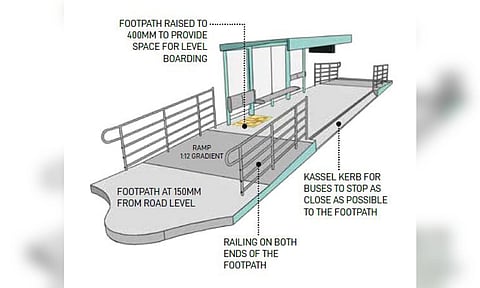

CHENNAI: To improve accessibility for persons with disability (PwD) and senior citizens, the Greater Chennai Corporation (GCC) has proposed a model bus shelter at the Vivekananda House bus stop on Kamarajar Salai, aiming to facilitate seamless boarding onto the newly introduced low-floor buses.
Since August 2024, the Metropolitan Transport Corporation (MTC) has rolled out low-floor buses designed to support PwDs, wheelchair users, and the elderly. However, commuters have pointed out that the absence of accessible bus stops hampers the effectiveness of the initiative.
“This low-floor bus shelter is a pilot project being implemented at a cost of ₹18.73 lakh,” said a GCC official. “Vivekananda House is a busy route with relatively light traffic, making it ideal for testing accessible infrastructure.”
According to the tender document, the shelter will feature ramps for barrier-free entry and exit, raised footpaths with skid-resistant tiles, and upgraded traffic kerbs to prevent vehicle encroachment. Traffic segregators will also be installed to guide pedestrian and vehicular movement and reduce the risk of accidents.
The MTC was forced to procure a larger number of low-floor buses following a prolonged legal battle waged by activist Vaishnavi Jayakumar. The court, in its order in May 2023, also directed all the municipal corporations that the bus stops should also be designed scientifically to suit the requirements of the disabled.
“Henceforth, any development/reconstruction/repairing/improvement in any of the bus stops should focus on making them disabled-friendly with due facility for wheelchairs to get into the low-floor bus from the platform,” it said.
R Sathish Kumar, a wheelchair user and disability rights advocate, stressed the need to raise footpaths to 400 mm to match bus floor height and install hand railings. “Installing Kassel kerbs will enable buses to dock closer to the platform. We’ve made progress with accessible buses, but without inclusive stops, the system is incomplete,” he pointed out.
Concurring with him was K Prabhu, a member of the December 3 Movement, who added: “Despite the introduction of low-floor buses, inaccessible shelters force PwDs to rely on assistance just to board a bus.”