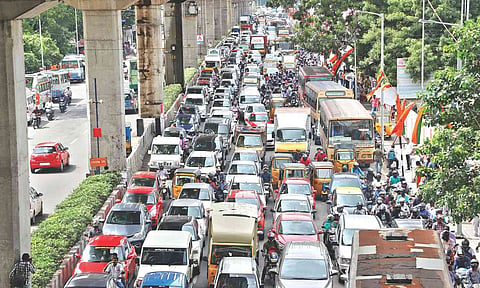

CHENNAI: The traffic in Chennai does not rest. A lone traffic cop handles the bustling Nelson Manickam Road - Aminjikarai junction, which during peak hours is a jarring medley of high-pitched horns and vrooming accelerators. At this stretch, it’s nearly a day-long ordeal.
Catching him at his brief break to know if the constant noise bothers him, the officer said, “I don’t hear it anymore.” But he did acknowledge that the stress is there.
The conversation on how constant noise affects our health, particularly its link to hypertension, is quite silent in India. Globally, hypertension accounts for about half of all heart disease and stroke-related deaths. “Noise can be one of the underrated causes of hypertension, especially in urban life,” said Dr SN Narasingan, vice president of the World Hypertension League.
In a 2021 report by the Central Pollution Control Board, Chennai was ranked as the noisiest city, surpassing the six other metros - Bengaluru, Hyderabad, Mumbai, Lucknow, Delhi and Kolkata.
The prescribed noise limit in residential areas is 55 dB during the day and 45 dB at night. It can go up to 75 dB in designated industrial zones. But as of May 20, even residential and commercial areas have routinely crossed over 80 dB.
Motorists who commute along Mount-Poonamallee Road are well-versed in the taxing experience of crossing the DLF IT Park. The hammering noise of the Metro Rail construction and the clashing of multiple horns from increasingly restless commuters are the tipping points on the stress scale.
The residents along this stretch toil an extra mile. “The nights are full of constant rambling of heavy vehicles and metro construction that will rumble our house. Most nights are sleepless,” said Archana, a Ramapuram resident, who is looking to move from the hullabaloo.
Unfortunately, industrial sounds, traffic sounds, extensive construction works, temple fests, political rallies and even the ‘Idiyaaaapam’ calls have become Chennai’s white noise. These sounds are not just about disrupting sleep. Studies suggest that prolonged exposure to stress from noise creates a fertile ground for hypertension.
“Each 10-decibel increase in noise level is associated with at least a 3–5 per cent higher risk of hypertension,” said Dr Venit Rose, a general physician.
“Cardiovascular risk factors like stroke, heart attack and arrhythmias are all related to hypertension. Some people have BP fluctuations due to kidney or cardiac issues. But for a certain percentage, we don’t know the cause of hypertension. Noise pollution comes under that category,” she added. “The patient is often unaware that their hypertension is triggered by the stress caused by noise.”
Psychiatrists say that noise pollution should not only be viewed through an environmental lens but also as a public mental health issue. “Our bodies perceive noise as a potential threat, triggering the release of stress hormones like cortisol. Over time, this can lead to both mental and physical health issues,” said Dr Vivian, a psychiatrist.
Several states have tried to study noise extensively and Tamil Nadu has been doing that too. A comprehensive noise mapping study in cities with populations exceeding 10 lakh, starting with Chennai, began in September 2024 in partnership with IIT-Madras. The project, supervised by the Tamil Nadu Pollution Control Board, was expected to deliver an initial report within three months. However, the data has not been made public, leaving any potential policy framework in limbo.
“We hope to get comprehensive data that will give us a clearer picture of what needs to be done, whether in terms of pollution control and health impacts,” said Sankarasubramaniyan, lab director at the TNPCB.
Meanwhile, enforcement remains scattered. Periodic seizures of vehicles with modified horns, bans on noisy silencers, and spot fines haven’t proven enough. The city and the State need to start taking noise pollution seriously, especially when diseases like hypertension lurk silently.
