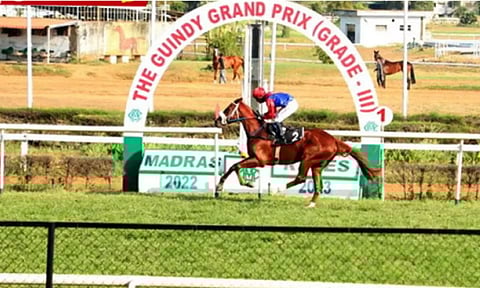

CHENNAI: The massive 118 acres of the retrieved Madras Race Club in Guindy will soon add to the city's green cover, as the Horticulture department has taken up the job to turn it into a sprawling eco-park. The department has floated tenders to rope in consultancy services for architecture, landscaping, and concept design for the new eco-park.
With a feasibility study done and a conceptual plan and design presented, the Guindy site will become the city's biggest eco-park sporting over 25 elements like flower beds with different colour schemes, floral tunnel, orchidarium, bonsai garden, cactus and succulents garden, butterfly garden, topiary structures, pergolas, open lawn, bird enclosures, arboretum, structures for indoor gardening, glass houses for exotic plants and flower, statues and sculptures, gazebos, footpath, stone benches, drainage scheme, irrigation scheme, garden illumination, children's play area with natural elements, cafeteria, dancing fountain, forest experience zone and nursery.
The Greater Chennai Corporation has also begun preparatory works to widen the four ponds inside the race club premises to reduce inundation in the southern part of the city.
The department of Horticulture and Plantation Crops has floated a tender to prepare a Detailed Project Report (DPR), and the methodology for the execution and maintenance of the garden shall be provided by the architect. All scope of services shall be undertaken under the terms of the agreement and coordination and collaboration with the Tamil Nadu Horticulture Development Agency (TANHODA) to develop the eco-park's design.
After the Madras Race Club's lease was cancelled and its land was acquired last year, the State had planned to expand it as a public space and develop the green cover of the city. The 118 acres of land, worth Rs 4,832 crore, was ordered to be transferred to the Horticulture department.
Since then, the works to build four new ponds covering 6.44 acres began and additional digging is under way to cover 5.83 acres more, covering 12.27 acres overall. The works are expected to be completed before the onset of the Northeast monsoon, as the existing ponds can store 4.60 million cubic feet of rainwater and can hold up to 8.77 million cubic feet with additional digging. Each pond spans from 0.86 acres to 1.18 acres and is 5 metres deep. The former racecourse complex spans 160 acres. Prior to building the ponds, rainwater would flow through Velachery, Pallavaram, and Pallikaranai swamps to reach Muttukadu.
Presenting a new solution to store rainwater and to prevent inundation in and around the area, GCC commissioner J Kumaragurubaran said, "The Chennai Corporation has decided to increase the storage capacity of these four ponds by widening and deepening. The ponds will help in better flood management for the Guindy, Velachery, and Adyar areas. Which increases the groundwater level."
He added that they have started the processes to desilt and improve the volume of ponds in the Chennai corporation. "We have started these works, as the city received unusual rain even before the onset of the northeast monsoon," said the commissioner.
When the MRC land was newly retrieved by the State, many shared their thoughts on converting the 160-acre parcel into the city's new lung. Ashok Vardhan Shetty, the former additional secretary of the Municipal Administration and Water Supply department, had told DT Next, "Chennai does not have enough green space. The government could develop a central park modelled after New York Central Park or Stanley Park in Vancouver with hiking trails and even allow people to go on a picnic. It would be a very useful green space in the middle of the city."
In any case, the government must make it a rule of thumb that the recreational space does not occupy more than 10 to 15 per cent of the total park area and close to 90 per cent of the park remains green and blue space, Shetty added. Arguing that it would be a cheaper way of augmenting the city's lung space, the former MAWS secretary cited how major cities like London and Singapore have 27 per cent and 46 per cent lung space.