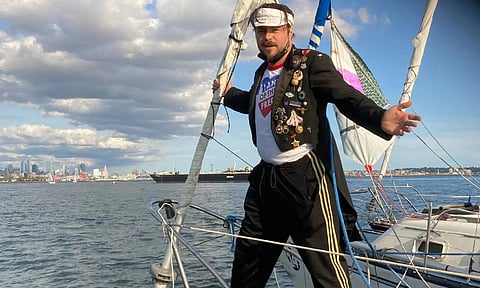

NEW YORK: Orien McNeill, an artist and impresario of New York City’s DIY and participatory art community, whose work was experiential, theatrical and ephemeral and took place mostly on the water — think “Burning Man, but with the possibility of drowning,” as one friend put it — died May 15 at his home, a 52-foot-long ferryboat docked on a Brooklyn creek. He was 45.
McNeill was an early pioneer of New York’s fetid waterways. He was among the first artists to homestead on the Gowanus Canal, a Superfund site in Brooklyn, which he did two decades ago in a 1953 Chris-Craft boat that he christened the Meth Lab. (It was not a meth lab.)
Soon, a cohort of street artists and dumpster-diving freegans — the anti-consumerist foragers of the late aughts — who might otherwise have been squatting in Brooklyn warehouses, were drawn to the same lawless territory, a last frontier and haven in the ever-gentrifying New York City boroughs. They made art from scavenged materials and held events that harked back to the Happenings of their 1960s predecessors, although the events were intended for no audience but themselves.
No critics were summoned, and not much was documented. McNeill was their pied piper, guru and pirate prankster, who hatched extravagant, loosely organised adventures involving costumes, flotillas of handmade rafts and, once, a pop-up bar on a sinking tugboat.
When Caledonia Curry, otherwise known as the artist Swoon, began to conceptualise “Swimming Cities” — winsome floating contraptions built from salvaged materials that she launched on the Hudson River in 2008 — McNeill, her classmate from Pratt Institute in Brooklyn, was an inspiration, project architect and co-pilot.
The following year, when she reimagined the project for Venice, McNeill played the same role. With a crew of nearly 30, Curry sent her materials to nearby Slovenia, where the shipping containers they were in were temporarily held up by customs inspectors: They were confused by the contents — they thought it was garbage.
The crew members built their fantastical crafts in Slovenia and sailed to Venice, where they crashed the annual Biennale, enchanting the assembled art crowd as the vessels floated through the canals. McNeill served as the escort and advance guard, scooting about in a battered skiff in case someone fell overboard.
“Orien introduced me to world building,” Curry said in an interview. “He was living this beautiful, feral existence on the water — the centre of this artist community. He shied away from the limelight, but his spirit informed everybody.”
Duke Riley, an artist known for releasing thousands of pigeons outfitted with LEDs into the night sky above the Brooklyn Navy Yard, as well as building a wooden replica of a Revolutionary War-era sub and launching it at the Queen Mary 2, was a co-conspirator on a variety of adventures.
One was the sinking bar, which McNeill persuaded Riley to help him build in a half-submerged tugboat with a rusted-out floor. The bar opened at low tide, and as the hours passed, guests eventually found themselves waist-deep in water. They swam out before the tide rose too high.